Because / Therefore — 因为 & 所以
Overview
因为 (yīnwèi) and 所以 (suǒyǐ) form the primary cause-and-effect pair in Mandarin. 因为 introduces the reason/cause and answers the question "Why?" (为什么); 所以 introduces the result/conclusion. Unlike English, which uses only "because" or "so" in one sentence, Mandarin commonly uses both together. They can also be used separately — but with one critical asymmetry: 因为 can stand alone, while 所以 always requires a preceding reason.
因为 introduces the cause; 所以 introduces the result. Use them together or separately — but 所以 always needs a preceding reason, while 因为 can stand alone.
Pattern(s)
| Pattern | Notes |
|---|---|
因为 [Cause], 所以 [Result] | Full pair — most explicit; “Because X, therefore Y” |
因为 [Cause], [Result] | 所以 dropped; cause is stressed |
[Cause], 所以 [Result] | 因为 dropped; result is stressed |
The pair is clause-level — both 因为 and 所以 precede full clauses, not single words.
Core Examples
| Chinese | Pinyin | English |
|---|---|---|
| 因为下雨了,所以我们没去公园。 | Yīnwèi xià yǔ le, suǒyǐ wǒmen méi qù gōngyuán. | Because it rained, we didn’t go to the park. |
| 因为努力学习,所以他考得很好。 | Yīnwèi nǔlì xuéxí, suǒyǐ tā kǎo de hěn hǎo. | Because he studied hard, he did well on the test. |
| 因为下雨,我们没去。 | Yīnwèi xià yǔ, wǒmen méi qù. | Because it rained, we didn’t go. |
| 他很忙,所以没来开会。 | Tā hěn máng, suǒyǐ méi lái kāihuì. | He was busy, so he didn’t come to the meeting. |
| 他病了,所以没来。 | Tā bìng le, suǒyǐ méi lái. | He got sick, so he didn’t come. |
因为 — Giving the Reason
To explain why something happens, use 因为. It introduces the reason or cause and answers the question "Why?" (为什么 — wèishénme). Place 因为 before the clause that gives the reason — this signals to the listener: "Here comes the explanation."
因为 introduces the reason or cause. It answers "Why?" — place it before the reason clause.
| Chinese | Pinyin | English |
|---|---|---|
| 因为下雨,我们没去。 | Yīnwèi xià yǔ, wǒmen méi qù. | Because it rained, we didn’t go. |
| 因为很累,他早睡了。 | Yīnwèi hěn lèi, tā zǎo shuì le. | Because he was tired, he went to bed early. |
| 因为便宜,我买了。 | Yīnwèi piányi, wǒ mǎi le. | Because it was cheap, I bought it. |
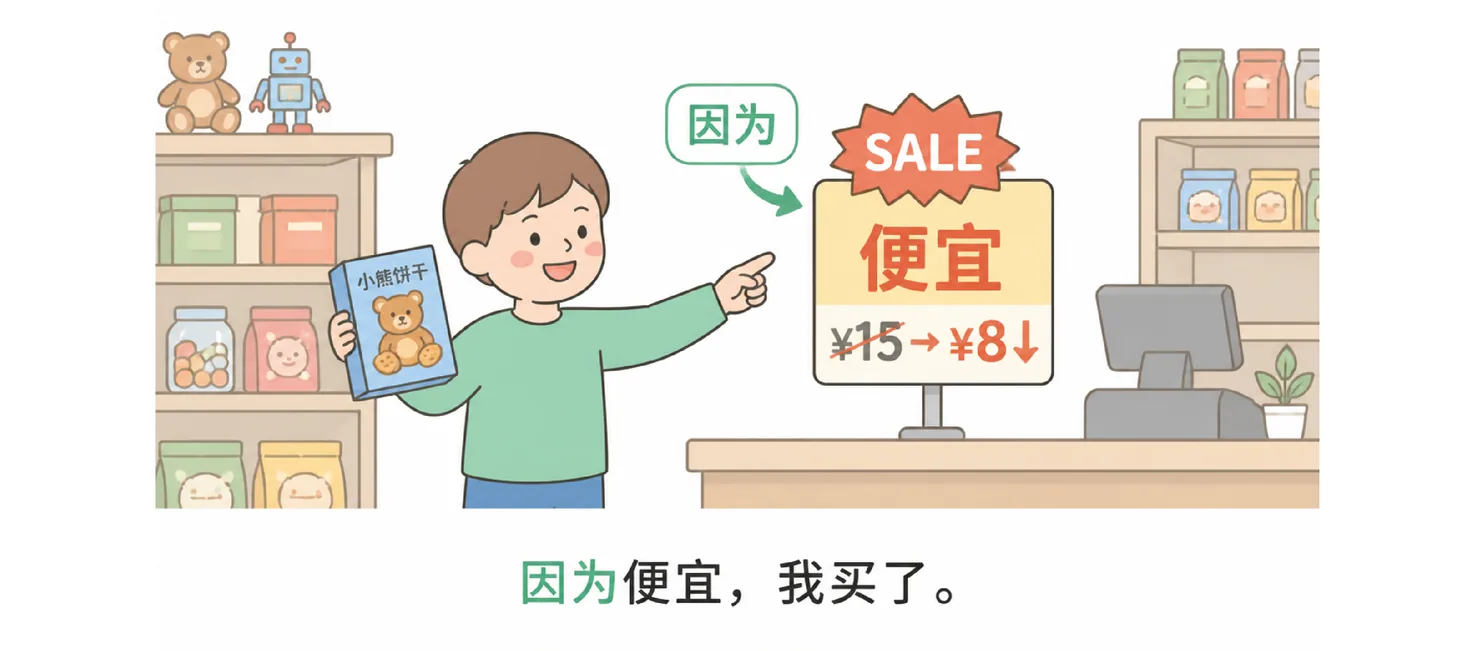 因为便宜,我买了。— Because it was cheap, I bought it.
💡 Position flexibility: 因为 can come at the beginning (emphasising the reason) or after the main clause (emphasising the result). Both are correct: 我没去,因为下雨了。 (I didn’t go, because it rained.)
The 因为…所以 Pair
Pair 因为 with 所以 (so / therefore) to form a complete cause-effect structure. While English typically uses only "because" OR "so" in a single sentence, Mandarin commonly uses both together. The 因为 clause sets up the cause, and the 所以 clause delivers the effect.
Pair 因为 with 所以 for a full cause → effect sentence. Both are used in the same sentence — unlike English, which chooses one or the other.
Pattern: 因为 + Reason, 所以 + Result
| Chinese | Pinyin | English |
|---|---|---|
| 因为下雨了,所以我们没去公园。 | Yīnwèi xià yǔ le, suǒyǐ wǒmen méi qù gōngyuán. | Because it rained, we didn’t go to the park. |
| 因为努力学习,所以他考得很好。 | Yīnwèi nǔlì xuéxí, suǒyǐ tā kǎo de hěn hǎo. | Because he studied hard, he did well on the test. |
| 因为天气冷,所以我不出门。 | Yīnwèi tiānqì lěng, suǒyǐ wǒ bù chūmén. | Because the weather is cold, I’m not going out. |
| 因为手机没电了,所以我打不了电话。 | Yīnwèi shǒujī méi diàn le, suǒyǐ wǒ dǎ bù liǎo diànhuà. | Because my phone has no battery, I can’t make calls. |
| 因为作业很多,所以他十一点才睡觉。 | Yīnwèi zuòyè hěn duō, suǒyǐ tā shíyī diǎn cái shuìjiào. | Because there was a lot of homework, he didn’t sleep until 11. |
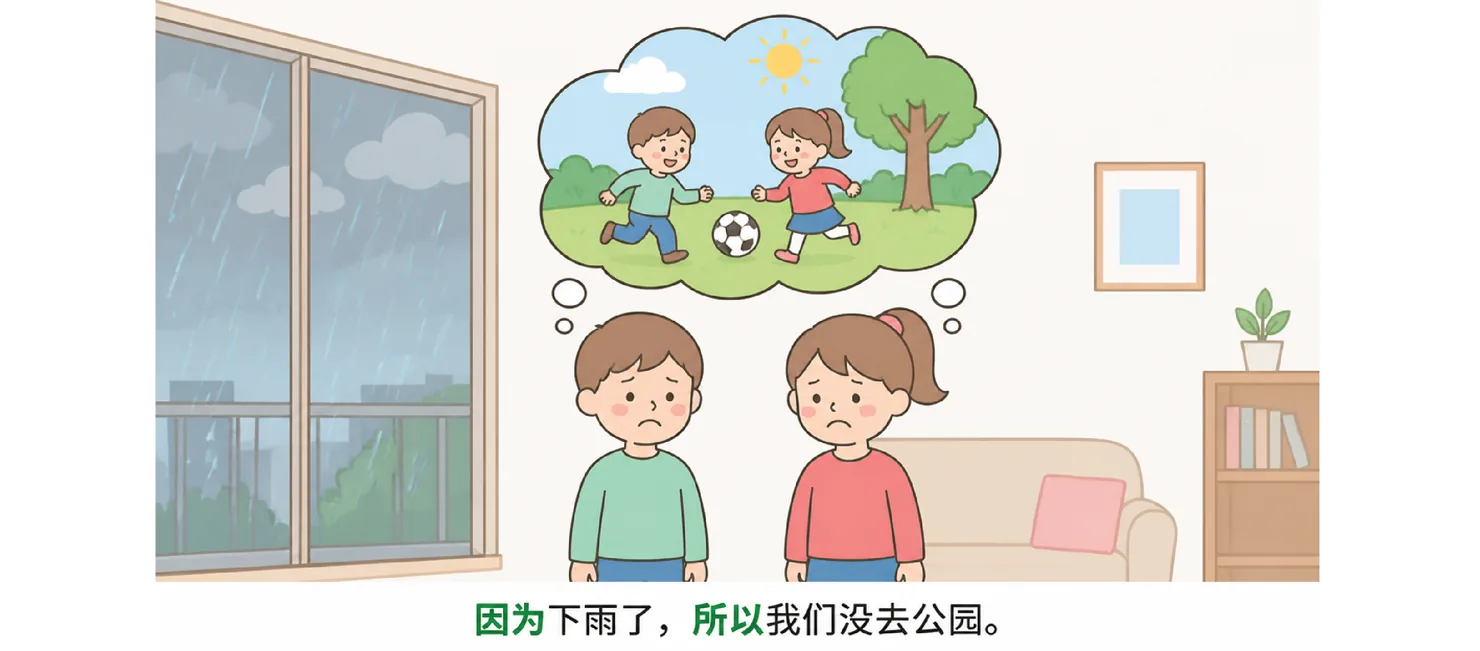 因为下雨了,所以我们没去公园。— Because it rained, we didn’t go to the park.
📝 Using 因为 alone is perfectly fine in casual conversation. The 因为…所以 pair is not required every time.
所以 Must Follow the Reason
所以 states a result, conclusion, or consequence. It always appears after the reason and signals that what follows is the logical outcome of what was just said. It cannot start a sentence unless the cause has already been clearly established in the previous sentence.
所以 introduces the result. It always follows a reason — it cannot start a sentence on its own.
| Chinese | Pinyin | English |
|---|---|---|
| 下雨了,所以比赛取消了。 | Xià yǔ le, suǒyǐ bǐsài qǔxiāo le. | It rained, so the match was cancelled. |
| 手机没电了,所以打不了电话。 | Shǒujī méi diàn le, suǒyǐ dǎ bù liǎo diànhuà. | The phone has no battery, so I can’t make calls. |
| 她哭了,所以眼睛红了。 | Tā kū le, suǒyǐ yǎnjīng hóng le. | She cried, so her eyes are red. |
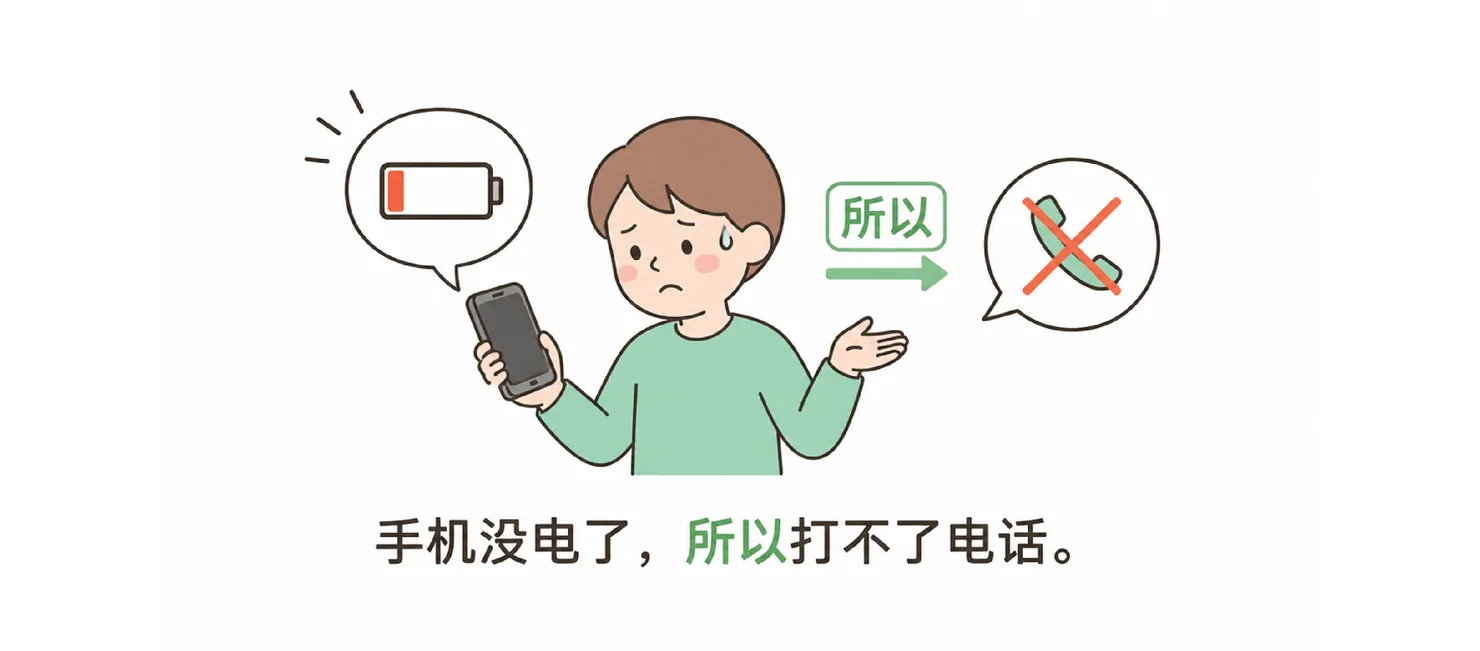 手机没电了,所以打不了电话。— The phone has no battery, so I can’t make calls.
The reason must always come first:
| Chinese | Pinyin | English | |
|---|---|---|---|
| ✅ Correct | 因为我工作很多,所以我很累。 | Yīnwèi wǒ gōngzuò hěn duō, suǒyǐ wǒ hěn lèi. | Because I have a lot of work, I’m very tired. |
| ❌ Incorrect | 所以我很累,因为我工作很多。 | Suǒyǐ wǒ hěn lèi, yīnwèi wǒ gōngzuò hěn duō. | (Incorrect order — the reason must come first) |
| Chinese | Pinyin | English | |
|---|---|---|---|
| ✅ Correct | 他病了,所以没来。 | Tā bìng le, suǒyǐ méi lái. | He was sick, so he didn’t come. |
| ❌ Incorrect | 所以没来。(no prior context) | Suǒyǐ méi lái. | (Missing the reason — 所以 needs a preceding cause) |
Exception in conversation: If the reason was just stated by another speaker, 所以 can stand alone. A: 我今天很累。 B: 所以早点睡吧。 (A: I’m very tired today. B: So go to bed early.) The cause was already established, so 所以 alone is natural.
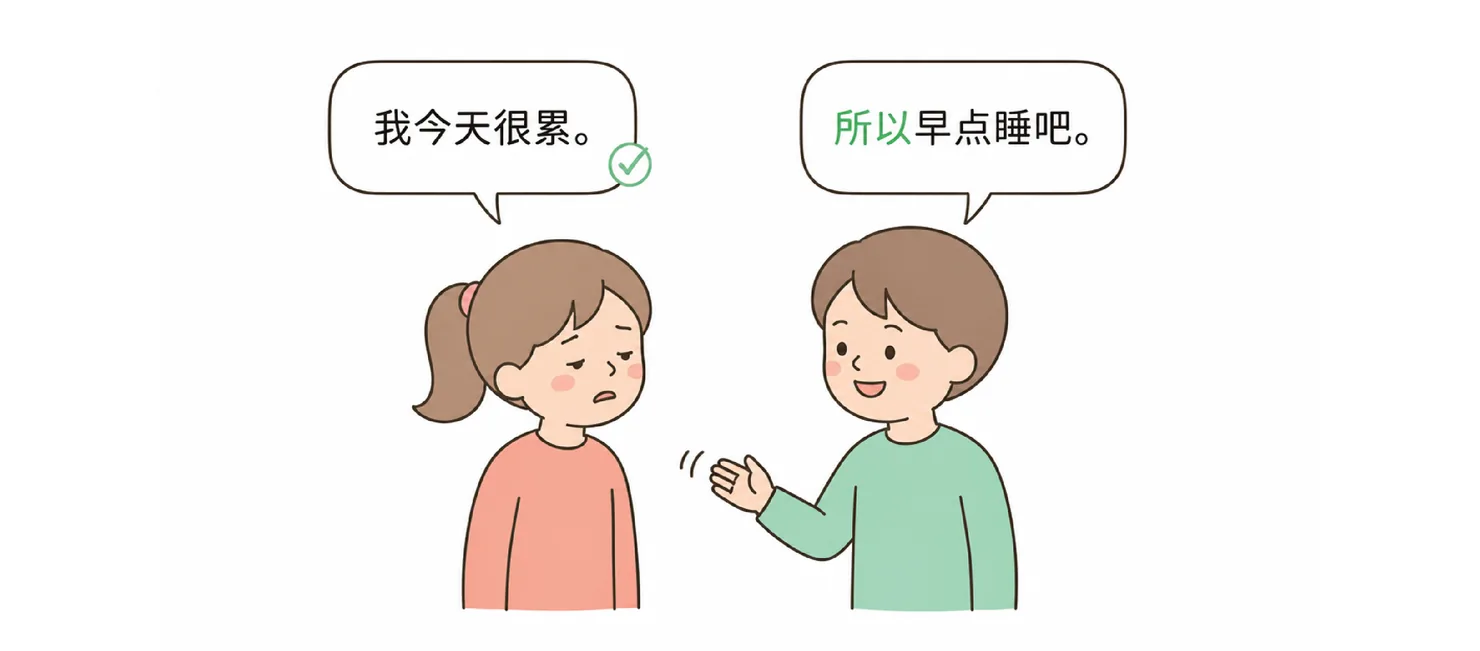 A: 我今天很累。B: 所以早点睡吧。— When the cause is already established in context, 所以 can stand alone in reply.
Drills
Fill in the blank with 因为 or 所以:
- 他昨天熬夜了,___ 今天很困。
- ___ 天气太热,我们决定去游泳。
- 妹妹哭了,___ 她的冰淇淋掉了。
- ___ 作业很多,他很晚才睡觉。
- 他很努力,___ 他进步很快。
- ___ 咖啡很苦,他加了糖。
- 她没来上课,___ 她生病了。
- ___ 明天有考试,我今天不出去玩。
- 他每天跑步,___ 身体很好。
- ___ 手机没电了,打不了电话。
Answer Key: 1. 所以 2. 因为 3. 因为 4. 因为 5. 所以 6. 因为 7. 因为 8. 因为 9. 所以 10. 因为
Notes
- In speech, dropping one half of the pair is natural and common. Keeping both (因为…所以…) sounds slightly more formal or emphatic.
- In written Chinese (essays, news), 因此 (yīncǐ) and 因而 (yīn’ér) are formal synonyms for 所以.
- For the casual “then” consequence (你努力,就会成功), use 就 rather than 所以.
Sources
HSK Standard Course 2 — 因为 / 所以 (L6) Mandarin Grammar References — Conjunctions chapter