Then / As a Result — 就
Overview
Use 就 to show that one action naturally or immediately follows another. It is more casual than 所以 and frequently appears in everyday conversation. The nuance of 就 is that the result is expected or obvious given the preceding situation. Place 就 before the verb that describes the natural consequence.
就 (jiù) shows an immediate, natural consequence — "then." More casual than 所以. Goes before the verb in the result clause.
Pattern(s)
| Pattern | Structure | Meaning |
|---|---|---|
| Natural consequence | Situation, (Subject) + 就 + Verb | ”…, then …” |
| Conditional | 如果 + Condition, (Subject) + 就 + Result | ”If …, then …” |
Core Examples
| Chinese | Pinyin | English |
|---|---|---|
| 你努力,就会成功。 | Nǐ nǔlì, jiù huì chénggōng. | If you work hard, (then) you will succeed. |
| 他来了,我们就开始。 | Tā lái le, wǒmen jiù kāishǐ. | He’s coming, (then) we’ll start. |
| 天黑了,就回家吧。 | Tiān hēi le, jiù huí jiā ba. | It’s getting dark, (so) let’s go home. |
| 吃完饭,就写作业。 | Chī wán fàn, jiù xiě zuòyè. | After eating, (then) do homework. |
| 下课后,就去图书馆。 | Xià kè hòu, jiù qù túshūguǎn. | After class, (then) go to the library. |
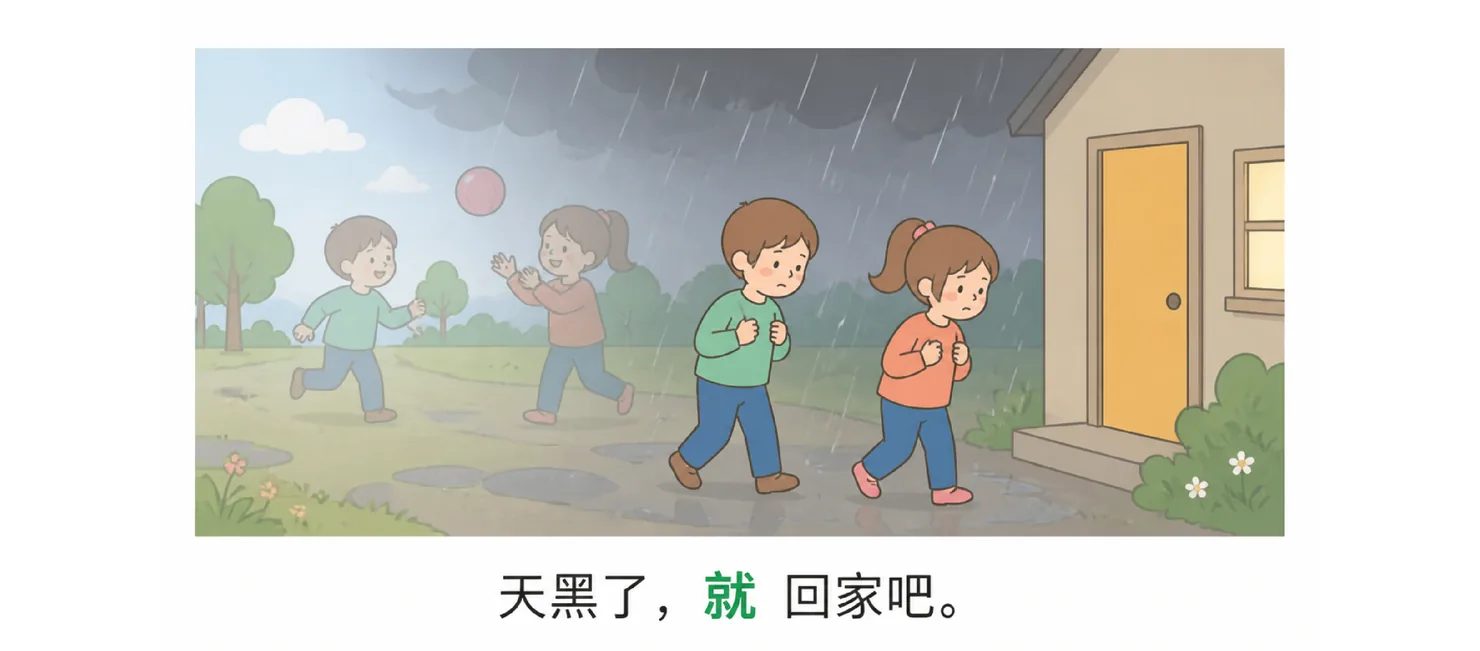 天黑了,就回家吧。— It’s getting dark, so let’s head home.
就 in Conditional Sentences with 如果
Pair 就 with 如果 (if) to express "if…then…" relationships. This pattern is extremely common in everyday Mandarin: the 如果 clause sets the condition, and 就 marks the result that follows from it.
Pair 就 with 如果 (if) for "if…then…" sentences — 如果 sets the condition, 就 marks the result.
Pattern: 如果 + Condition, 就 + Result
| Chinese | Pinyin | English |
|---|---|---|
| 如果你来,我就高兴。 | Rúguǒ nǐ lái, wǒ jiù gāoxìng. | If you come, I’ll be happy. |
| 如果下雨,我就不去。 | Rúguǒ xià yǔ, wǒ jiù bù qù. | If it rains, I won’t go. |
| 如果饿了,就吃饭。 | Rúguǒ è le, jiù chīfàn. | If you’re hungry, then eat. |
| 如果不会,就问老师。 | Rúguǒ bú huì, jiù wèn lǎoshī. | If you don’t know, ask the teacher. |
| 如果明天不下雨,我们就去爬山。 | Rúguǒ míngtiān bù xià yǔ, wǒmen jiù qù páshān. | If it doesn’t rain tomorrow, we’ll go hiking. |
就 vs. 所以 — Choosing the Right One
Both 就 and 所以 express results, but they serve different functions. 所以 is more formal and states a reasoned, logical conclusion; 就 is more casual and marks a natural, immediate consequence.
Both express results: 所以 is formal (a reasoned conclusion); 就 is casual (a natural, immediate consequence).
| Aspect | 所以 (suǒyǐ) | 就 (jiù) |
|---|---|---|
| Formality | More formal; suitable for writing | More casual; common in conversation |
| Meaning | ”Therefore” — a logical conclusion | ”Then” — a natural, immediate consequence |
| Focus | Emphasises logical reasoning | Emphasises immediacy and natural flow |
| Chinese | Pinyin | English | |
|---|---|---|---|
| ✅ Correct | 你努力,就会成功。 | Nǐ nǔlì, jiù huì chénggōng. | Work hard, and you’ll succeed. |
| ❌ Incorrect | 你努力,所以会成功。 | Nǐ nǔlì, suǒyǐ huì chénggōng. | (所以 sounds too formal here — 就 is natural for an expected consequence) |
| Chinese | Pinyin | English | |
|---|---|---|---|
| ✅ Correct | 他很努力,所以成功了。 | Tā hěn nǔlì, suǒyǐ chénggōng le. | He worked hard, so he succeeded. |
| ❌ Incorrect | 他很努力,就成功了。 | Tā hěn nǔlì, jiù chénggōng le. | (就 sounds too casual — 所以 is better for a reasoned logical conclusion) |
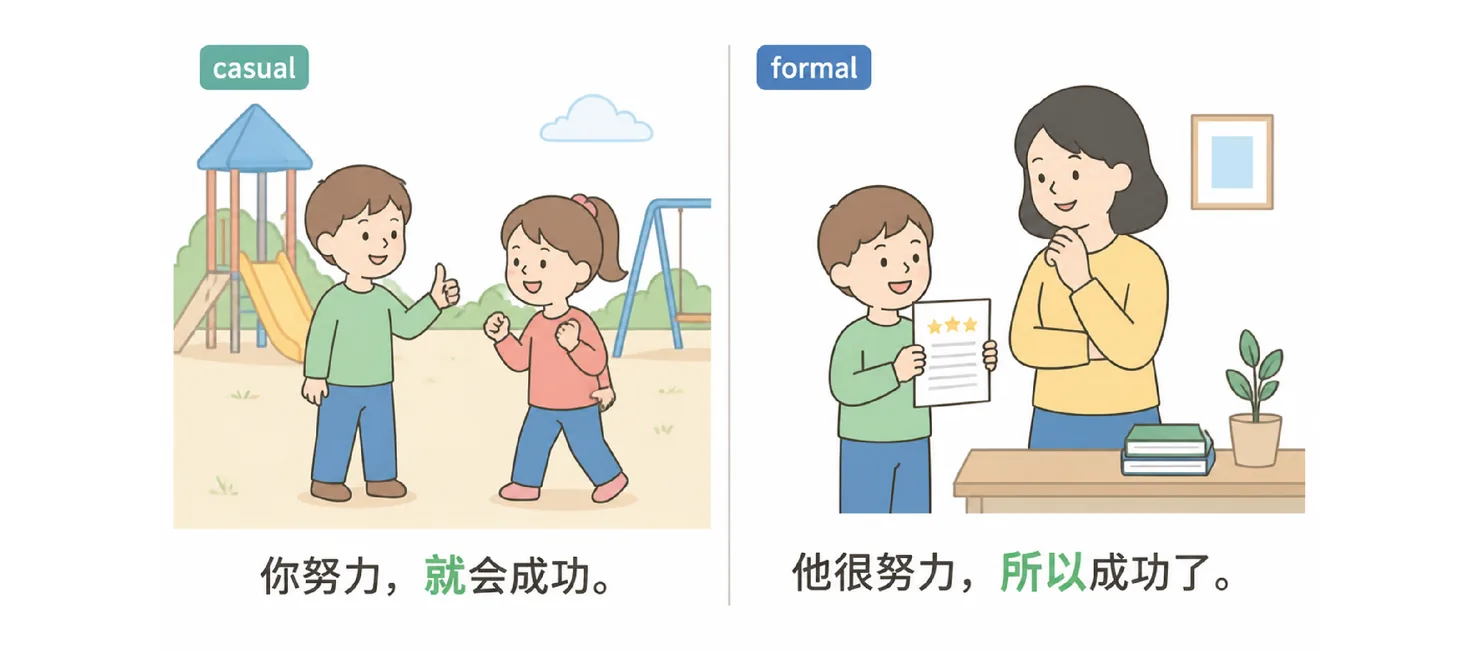 就 suits casual, immediate consequences. 所以 suits formal, reasoned conclusions.
Drills
Choose 就 or 所以 to fill each blank:
- 你写完作业,___ 可以玩游戏。
- 下雨了,___ 比赛取消了。
- 你按下开关,灯 ___ 会亮。
- 他迟到了,___ 被老师批评了。
- 吃完了饭,___ 去看电视。
- 他很聪明,___ 很快学会了。
- 如果你想学中文,___ 每天都要练习。
- 天黑了,___ 回家吧。
- 她每天都学习,___ 成绩很好。
- 下课后,___ 去图书馆。
- 如果你来,我 ___ 很高兴。
- 如果不会,___ 问老师。
Answer Key: 1. 就 2. 所以 3. 就 4. 所以 5. 就 6. 所以 7. 就 8. 就 9. 所以 10. 就 11. 就 12. 就
Notes
- 就 has many uses in Mandarin beyond showing consequence (e.g. “only,” “as early as,” emphasis). This page covers its connective use — linking a situation to its natural or conditional result.
- In the 如果…就 pattern, 如果 can be dropped in casual speech while 就 stays: 饿了就吃饭。(“If you’re hungry, eat.”)
Sources
HSK Standard Course 2 — 就 (L10) Mandarin Grammar References — Conjunctions chapter