Although…But — 虽然…但是
Overview
Use 虽然…但是 to express concession — you acknowledge one fact while simultaneously emphasising a contrasting fact. In Mandarin you must use both parts together, unlike English which uses only one ("although" OR "but"). 虽然 means "although" and sets up the concession; 但是 means "but" and introduces the contrasting result. Together they signal: "I acknowledge this first point — but despite that, here's the second."
虽然…但是 = "although…but." Both parts are required in Mandarin — you cannot use 虽然 alone without 但是 to complete the pair.
Pattern(s)
| Pattern | Notes |
|---|---|
虽然 [Concession], 但是 [Contrast] | Standard; both parts required |
虽然 [Concession], 可是 [Contrast] | 可是 as softer alternative to 但是 |
虽然 [Concession], 还是 [Result] | ”Still / nevertheless” — result happens anyway |
Key difference from English: You CANNOT drop 但是 after 虽然 in Mandarin. ❌ 虽然难,有用。 ✅ 虽然难,但是有用。
Core Examples
| Chinese | Pinyin | English |
|---|---|---|
| 虽然难,但是有用。 | Suīrán nán, dànshì yǒu yòng. | Although it’s difficult, it’s useful. |
| 虽然贵,但是质量很好。 | Suīrán guì, dànshì zhìliàng hěn hǎo. | Although it’s expensive, the quality is good. |
| 虽然下雨了,但是比赛继续了。 | Suīrán xià yǔ le, dànshì bǐsài jìxù le. | Although it rained, the match continued. |
| 虽然很累,但是完成了工作。 | Suīrán hěn lèi, dànshì wánchéng le gōngzuò. | Although tired, he finished the work. |
| 虽然贵,但是值得。 | Suīrán guì, dànshì zhíde. | Although it’s expensive, it’s worth it. |
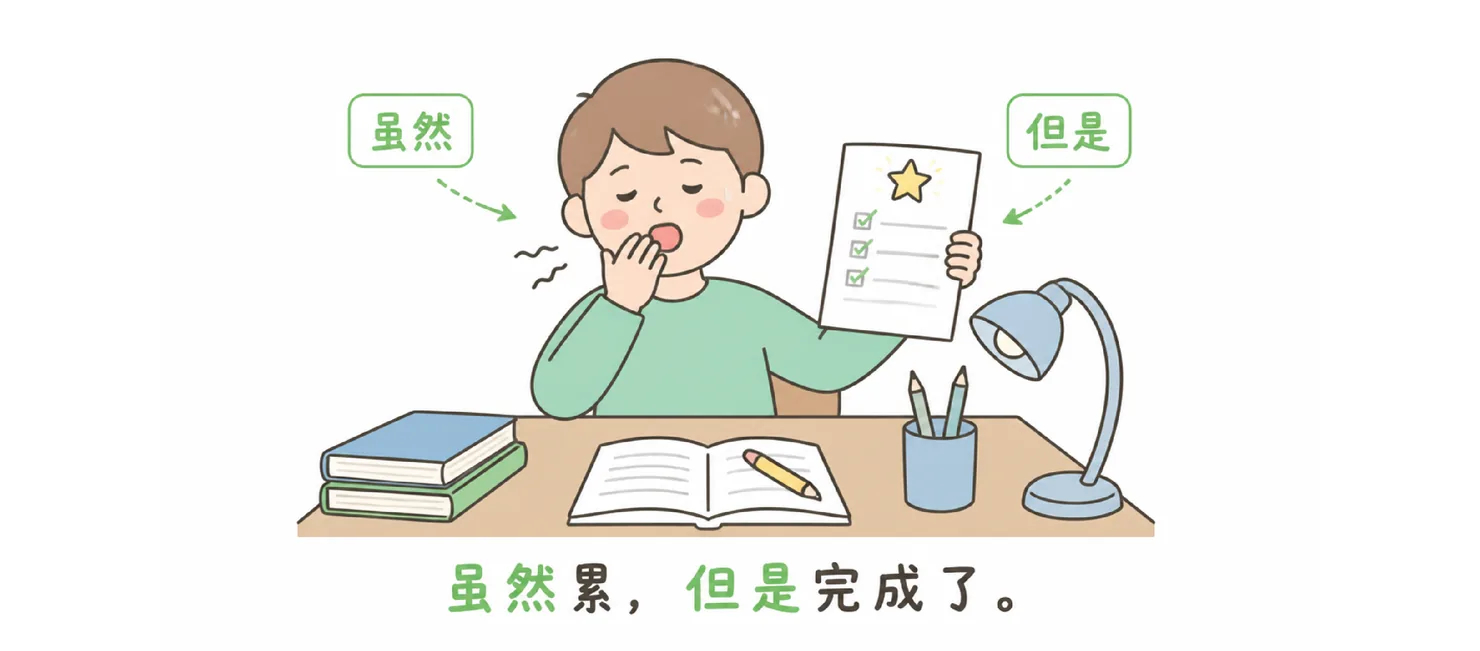 虽然累,但是完成了。— Although tired, the work was finished.
Both Parts Are Required
Using 虽然 without 但是 is grammatically incomplete in Mandarin. The two words form a bridge — remove either one and the structure collapses. You may replace 但是 with 可是 (softer) or 还是 ("still"), but one of them must close the pair.
虽然 needs a closing 但是 (or 可是 / 还是) — 虽然 alone is incomplete in Mandarin.
| Chinese | Pinyin | English | |
|---|---|---|---|
| ✅ Correct | 虽然难,但是有用。 | Suīrán nán, dànshì yǒu yòng. | Although it’s difficult, it’s useful. |
| ❌ Incorrect | 虽然难,有用。 | Suīrán nán, yǒu yòng. | (Missing 但是 — the pair must be complete) |
| Chinese | Pinyin | English | |
|---|---|---|---|
| ✅ Correct | 虽然贵,但是值得。 | Suīrán guì, dànshì zhíde. | Although it’s expensive, it’s worth it. |
| ❌ Incorrect | 虽然贵,值得。 | Suīrán guì, zhíde. | (Missing 但是 — the pair must be complete) |
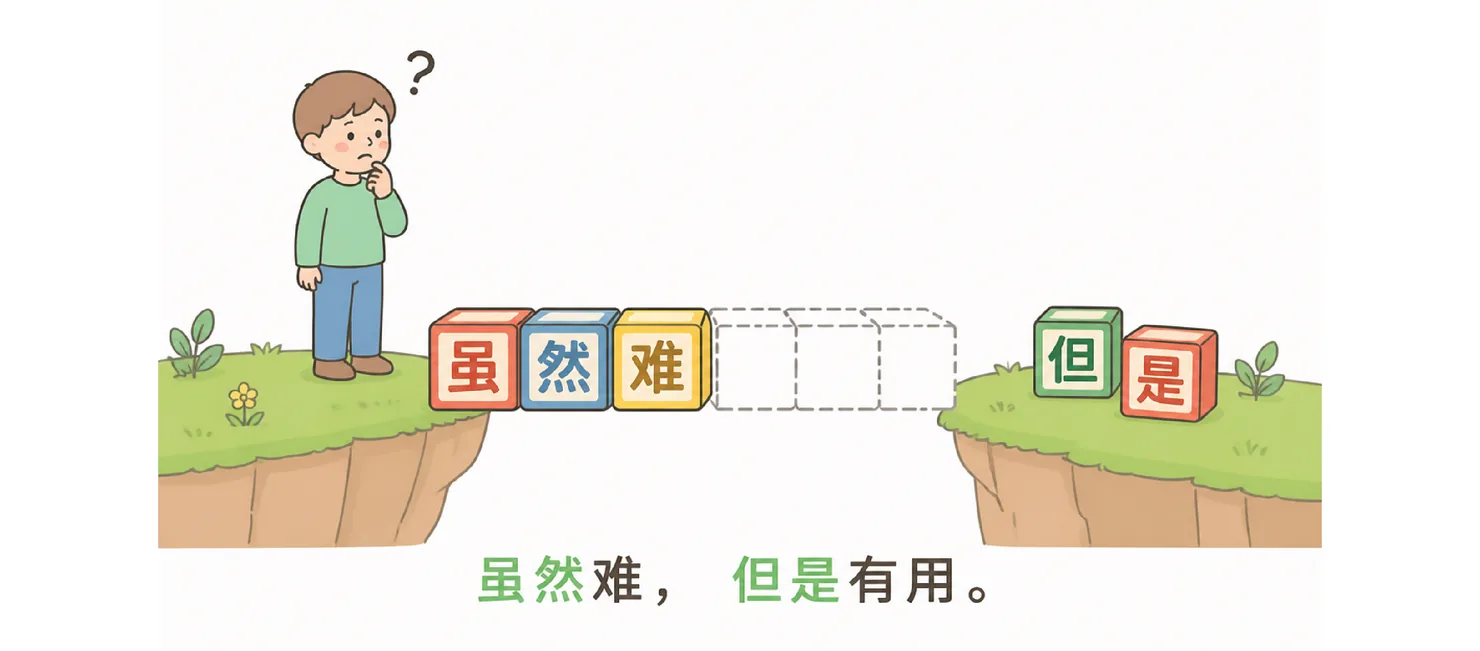 虽然…但是: both parts form a bridge — removing either one leaves the structure incomplete.
📝 You can also use 可是 instead of 但是: 虽然贵,可是质量很好。 This gives a slightly softer tone.
虽然…但是 vs. 但是 Alone
但是 on its own marks a simple contrast. Adding 虽然 at the front turns it into a concession — it acknowledges the first fact more strongly, making the contrasting result feel more unexpected ("even though…").
但是 alone = simple contrast. 虽然…但是 = concession — a stronger, "even though" contrast.
| Structure | When to Use |
|---|---|
| 但是 alone | Simple contrast. “He studied, but he didn’t pass.” |
| 虽然…但是 | Concession. “Even though he studied, he didn’t pass.” Stronger — the result is more unexpected. |
| Chinese | Pinyin | English |
|---|---|---|
| 他努力了,但是没成功。 | Tā nǔlì le, dànshì méi chénggōng. | He tried, but didn’t succeed. |
| 虽然努力了,但是没成功。 | Suīrán nǔlì le, dànshì méi chénggōng. | Although he tried, he didn’t succeed. (stronger contrast) |
| 这家店的东西贵,但是质量好。 | Zhè jiā diàn de dōngxi guì, dànshì zhìliàng hǎo. | Things at this store are expensive, but the quality is good. |
| 虽然这家店的东西贵,但是质量好。 | Suīrán zhè jiā diàn de dōngxi guì, dànshì zhìliàng hǎo. | Although things here are expensive, the quality is good. (acknowledges the cost more strongly) |
Confusing 虽然…但是 with 因为…所以
虽然…但是 shows concession (a contrast despite one fact). 因为…所以 shows cause and effect (one fact explains another). They serve entirely different logical functions, so swapping them changes the meaning completely.
虽然…但是 = concession (contrast despite a fact). 因为…所以 = cause and effect. They are not interchangeable.
| Chinese | Pinyin | English | |
|---|---|---|---|
| ✅ Correct | 虽然很累,但是完成了工作。 | Suīrán hěn lèi, dànshì wánchéng le gōngzuò. | Although he was tired, he finished the work. |
| ❌ Incorrect | 因为很累,所以完成了工作。 | Yīnwèi hěn lèi, suǒyǐ wánchéng le gōngzuò. | (Wrong — being tired doesn’t explain finishing the work; it contrasts with it) |
| Chinese | Pinyin | English | |
|---|---|---|---|
| ✅ Correct | 虽然身体不好,但是很努力。 | Suīrán shēntǐ bù hǎo, dànshì hěn nǔlì. | Although his health is not good, he works very hard. |
| ❌ Incorrect | 因为身体不好,所以很努力。 | Yīnwèi shēntǐ bù hǎo, suǒyǐ hěn nǔlì. | (Wrong — poor health doesn’t explain working hard; it contrasts with what you’d expect) |
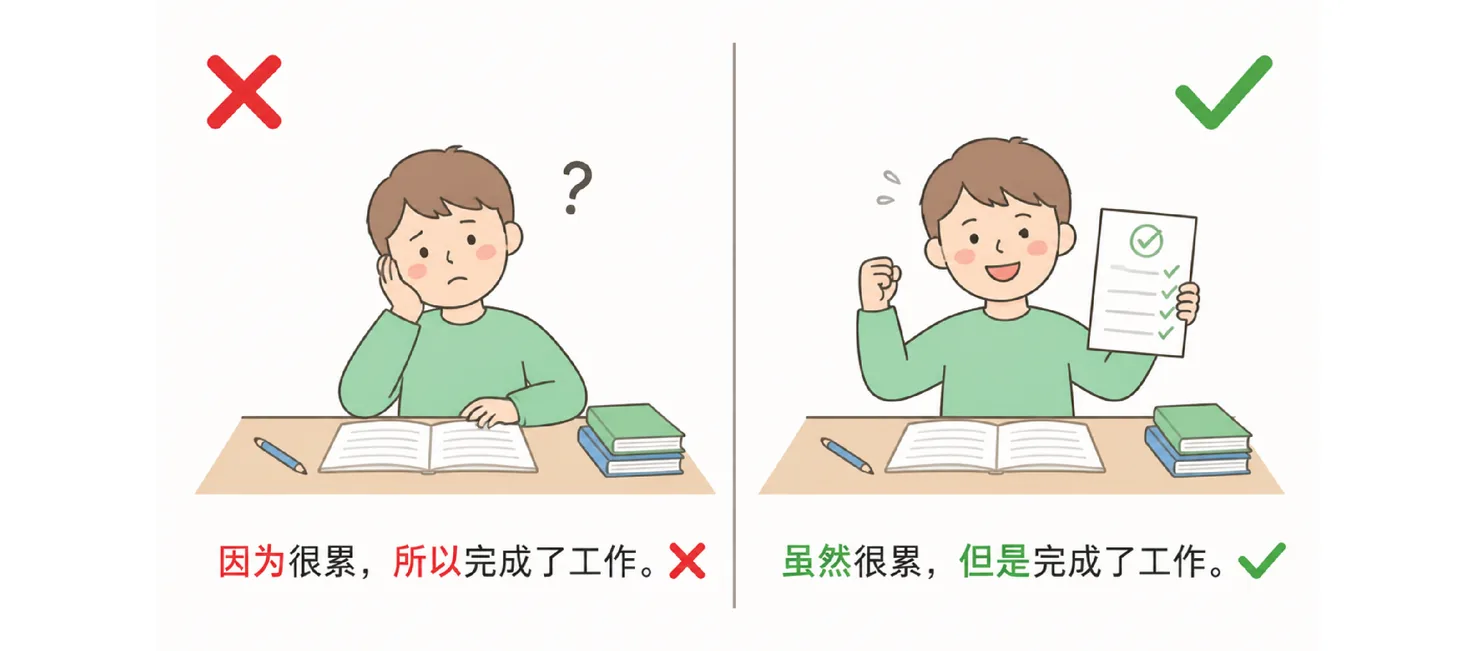 虽然…但是 = concession (despite being tired). 因为…所以 = cause-effect (because of tiredness). They are not interchangeable.
Drills
Choose 因为…所以 or 虽然…但是 for each pair of blanks:
- ___ 他很累,___ 还是完成了工作。
- ___ 这个手机旧,___ 很好用。
- ___ 她年纪小,___ 很懂事。
- ___ 路很远,___ 我们走到了。
- ___ 天气不好,___ 我们没去公园。
- ___ 他很努力,___ 成功了。
- ___ 这个菜很辣,___ 很好吃。
- ___ 他生病了,___ 没来上课。
- ___ 考试很难,___ 他考得很好。
- ___ 她没吃饭,___ 现在很饿。
Answer Key: 1. 虽然/但是 2. 虽然/但是 3. 虽然/但是 4. 虽然/但是 5. 因为/所以 6. 因为/所以 7. 虽然/但是 8. 因为/所以 9. 虽然/但是 10. 因为/所以
Notes
- 尽管…但是 (jǐnguǎn…dànshì) is a more formal/literary synonym for 虽然…但是.
- When the subject is the same in both clauses, it typically appears after 虽然: 虽然他很累,但是他还是完成了。 The second subject is often dropped: 虽然他很累,但是还是完成了。
Sources
HSK Standard Course 2 — 虽然…但是 (L14) Mandarin Grammar References — Conjunctions chapter