If / Then — 如果…就
Overview
Use 如果 to introduce a condition — "if X." It is almost always paired with 就 (jiù) in the result clause, which signals that the consequence flows naturally from the condition. Together they form Mandarin's standard if-then structure. Place 如果 before the condition clause; the result clause follows, often introduced by 就. 要是 (yàoshi) is a colloquial alternative to 如果 with identical grammar.
如果 introduces a condition. Pair it with 就 to form "if…then…" sentences. 要是 is the colloquial alternative — same grammar.
Pattern(s)
| Pattern | Notes |
|---|---|
如果 [Condition], 就 [Result] | Standard conditional; formal & spoken |
要是 [Condition], 就 [Result] | Colloquial variant; same grammar as 如果 |
如果 [Condition], [Result] | 就 can be omitted in informal speech |
就 is placed before the verb of the result clause, not before the subject: 如果你来,我就做饭 ✅ (not 就我做饭 ❌).
Core Examples
| Chinese | Pinyin | English |
|---|---|---|
| 如果你来,我就做饭。 | Rúguǒ nǐ lái, wǒ jiù zuò fàn. | If you come, (then) I’ll cook. |
| 如果明天下雨,我们就不去。 | Rúguǒ míngtiān xià yǔ, wǒmen jiù bù qù. | If it rains tomorrow, we won’t go. |
| 如果累了,就休息一下。 | Rúguǒ lèi le, jiù xiūxi yíxià. | If you’re tired, take a rest. |
| 如果不知道,就问老师。 | Rúguǒ bù zhīdào, jiù wèn lǎoshī. | If you don’t know, ask the teacher. |
| 要是下雨,我们就不去了。 | Yàoshi xià yǔ, wǒmen jiù bú qù le. | If it rains, we won’t go. |
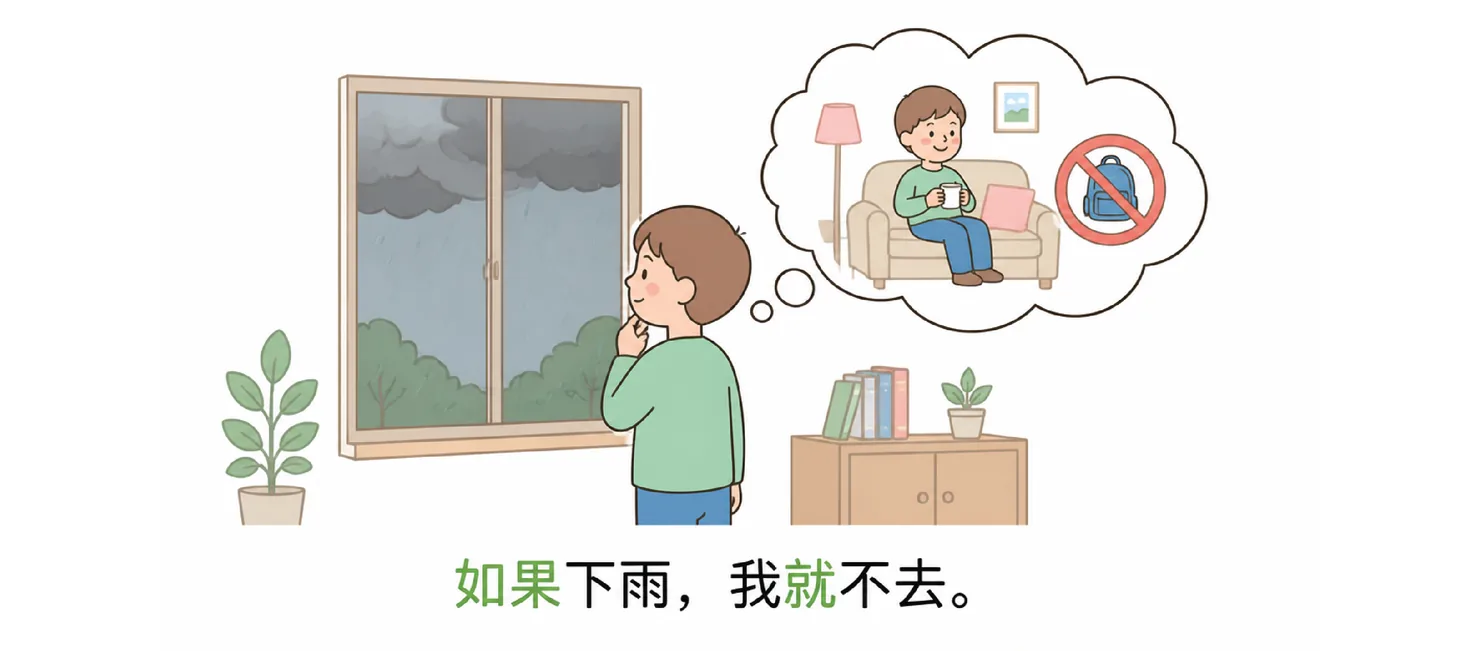 如果下雨,我就不去。— If it rains, I won’t go.
More 如果…就 Examples
The condition clause sets up a situation; the 就 clause states what follows if that situation holds. This pattern is one of the most common sentence frames in everyday Mandarin — for plans, advice, and cause-and-effect predictions alike.
如果 sets the condition, 就 states the result — the everyday frame for plans, advice, and predictions.
| Chinese | Pinyin | English |
|---|---|---|
| 如果有时间,我就去看你。 | Rúguǒ yǒu shíjiān, wǒ jiù qù kàn nǐ. | If I have time, I’ll go see you. |
| 如果不会,就问老师。 | Rúguǒ bú huì, jiù wèn lǎoshī. | If you don’t know, ask the teacher. |
| 如果写完作业,就可以看电视。 | Rúguǒ xiě wán zuòyè, jiù kěyǐ kàn diànshì. | If you finish your homework, you can watch TV. |
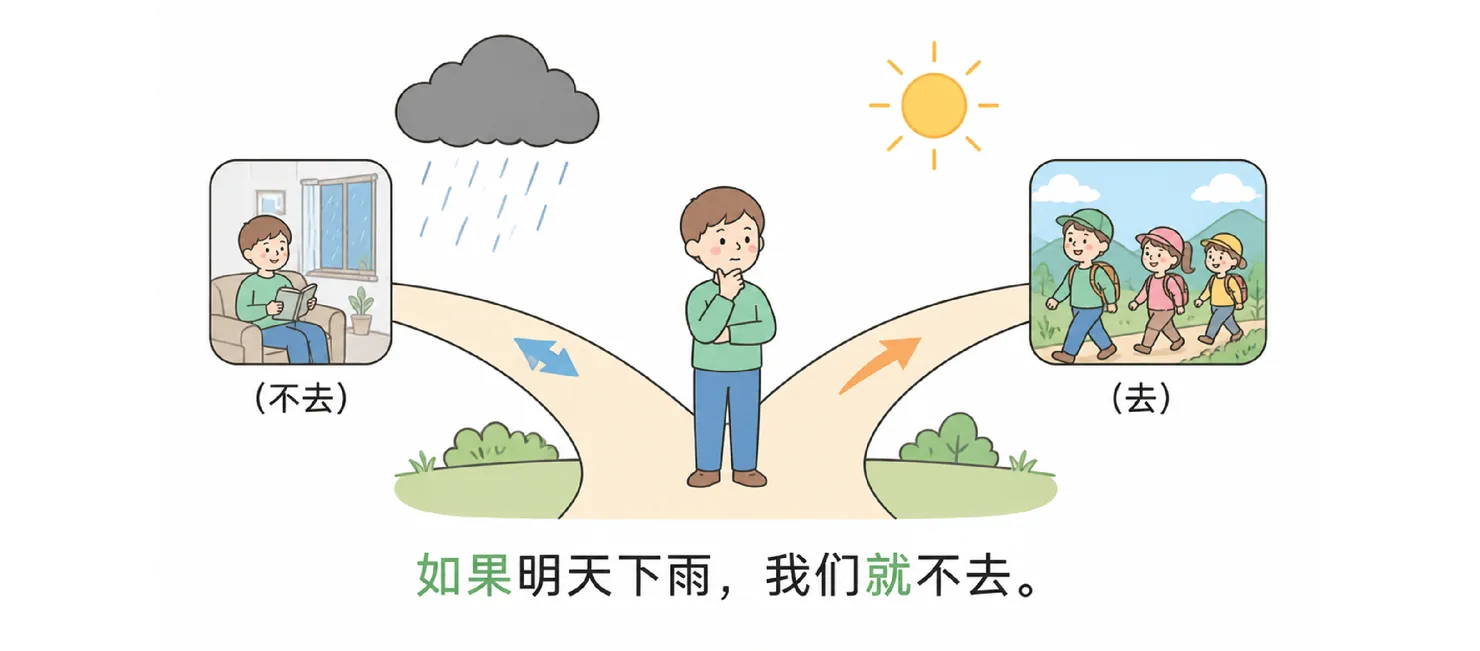 如果明天下雨,我们就不去。— If it rains tomorrow, we won’t go. The condition creates two possible paths.
要是 — Colloquial Alternative
要是 has the same meaning as 如果 but is more colloquial — common in casual conversation. The grammar is identical, so you can swap 要是 in for 如果 in any of the patterns above without changing anything else.
要是 means the same as 如果 but is more casual/colloquial. The grammar is identical — swap it in freely in speech.
| Word | Pinyin | Meaning | Register |
|---|---|---|---|
| 如果 | rúguǒ | If | Neutral — suitable for speech and writing |
| 要是 | yàoshi | If | Colloquial — more common in casual speech |
| Chinese | Pinyin | English | Nuance |
|---|---|---|---|
| 要是你来了,就好了。 | Yàoshi nǐ lái le, jiù hǎo le. | If you had come, it would have been great. | Colloquial, everyday speech. |
| 如果明天可以,我们去。 | Rúguǒ míngtiān kěyǐ, wǒmen qù. | If we can tomorrow, we’ll go. | Slightly more formal. |
| 要是下雨的话,我们就不去了。 | Yàoshi xià yǔ dehuà, wǒmen jiù bù qù le. | If it rains, we won’t go. | Very natural in conversation. |
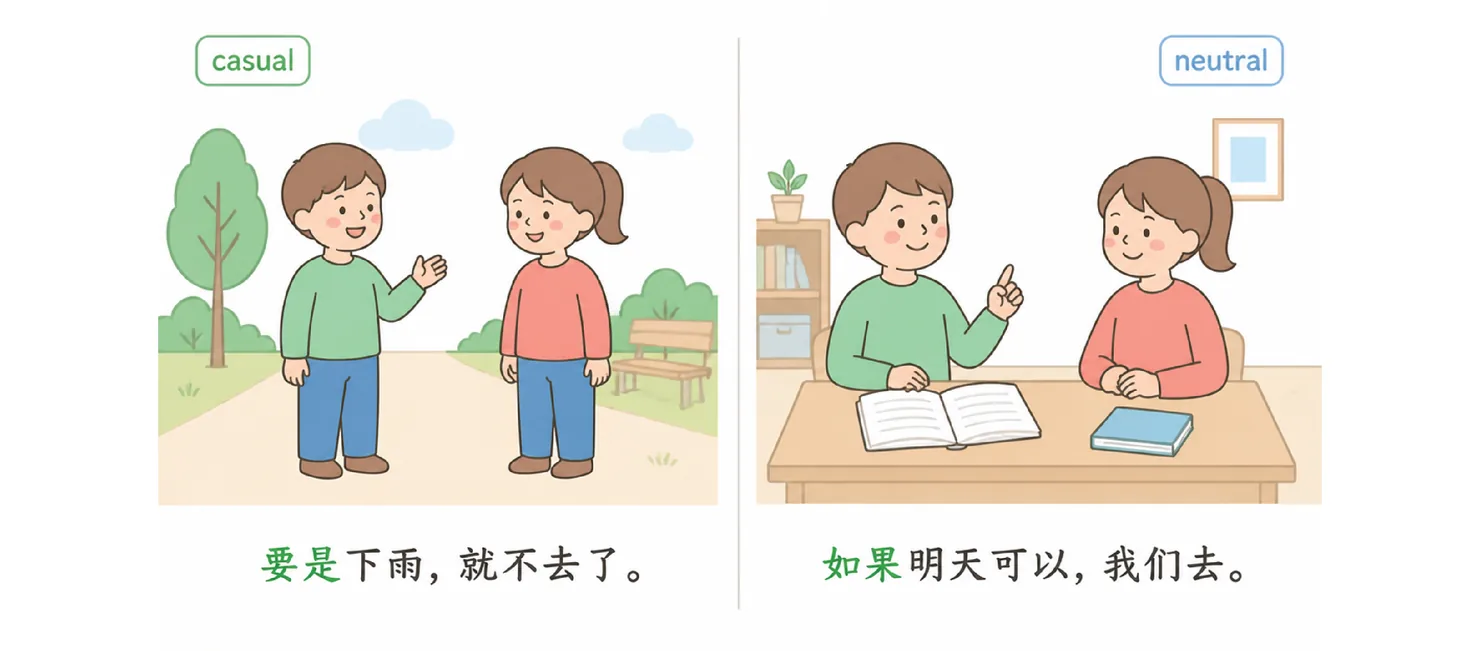 要是 feels casual and conversational. 如果 works comfortably in both casual and formal contexts.
📝 Note about 的话 (dehuà): You’ll often see 如果 or 要是 followed by 的话 in casual speech — it makes the condition feel more conversational. Example: 如果你来的话,我们就去。 (If you come, we’ll go.)
如果…就 vs. 因为…所以
如果…就 introduces a hypothetical condition that is not yet true, while 因为…所以 states a known cause that has already happened. Choosing the wrong pair changes the meaning from "if it rains" to "because it rained."
如果…就 = a hypothetical, not-yet-true condition; 因为…所以 = a known cause that already happened.
| 如果…就 | 因为…所以 | |
|---|---|---|
| Type | Hypothetical condition | Known cause |
| Reality | Not yet true / uncertain | Already true |
| Example (Chinese) | 如果下雨,我就不去。 | 因为下雨了,所以我没去。 |
| Example (English) | If it rains, I won’t go. (it might rain) | Because it rained, I didn’t go. (it did rain) |
Drills
Fill in the blank with 如果 or 就:
- ___ 你明天有空,我们一起去爬山吧。
- 你按时吃药,病 ___ 会好得快。
- ___ 天气好,我们 ___ 去海边。
- 要是你不喜欢,___ 换一个。
- ___ 你有问题,可以问老师。
- ___ 你来,我 ___ 很高兴。
- ___ 下雨,我 ___ 不去。
- ___ 饿了,就吃饭。
- 如果不会,___ 问老师。
- ___ 明天不下雨,我们 ___ 去爬山。
Answer Key: 1. 如果 2. 就 3. 如果 / 就 4. 就 5. 如果 6. 如果 / 就 7. 如果 / 就 8. 如果 9. 就 10. 如果 / 就
Notes
- 要是 sounds warmer and more conversational; 如果 is safe in all contexts.
- The condition clause (如果…) can come after the result clause in informal speech, but the standard order is condition → result.
- 万一 (wànyī, “in case / what if”) is used for low-probability or unwanted conditions: 万一下雨,我们怎么办?
Sources
HSK Standard Course 3 — 如果…就 (L16) HSK Standard Course 3 — 要是 (L11) Mandarin Grammar References — Conjunctions chapter