清楚 as a Result Complement — Clearly
Overview
清楚 (qīngchǔ) is a result complement meaning an action was carried out — or a perception landed — clearly. When you attach 清楚 to a verb, you are saying the action produced clarity: the thing was distinctly seen, distinctly heard, or distinctly expressed. 看清楚 is "see clearly," 听清楚 is "hear clearly," 说清楚 is "say clearly." Unusually, 清楚 is a two-syllable complement, unlike the single-syllable 完, 到 or 懂, which gives it a slightly weightier, more deliberate feel.
清楚 (qīngchǔ) says the action came out clearly: 看清楚 (saw clearly), 听清楚 (heard clearly), 说清楚 (said clearly).
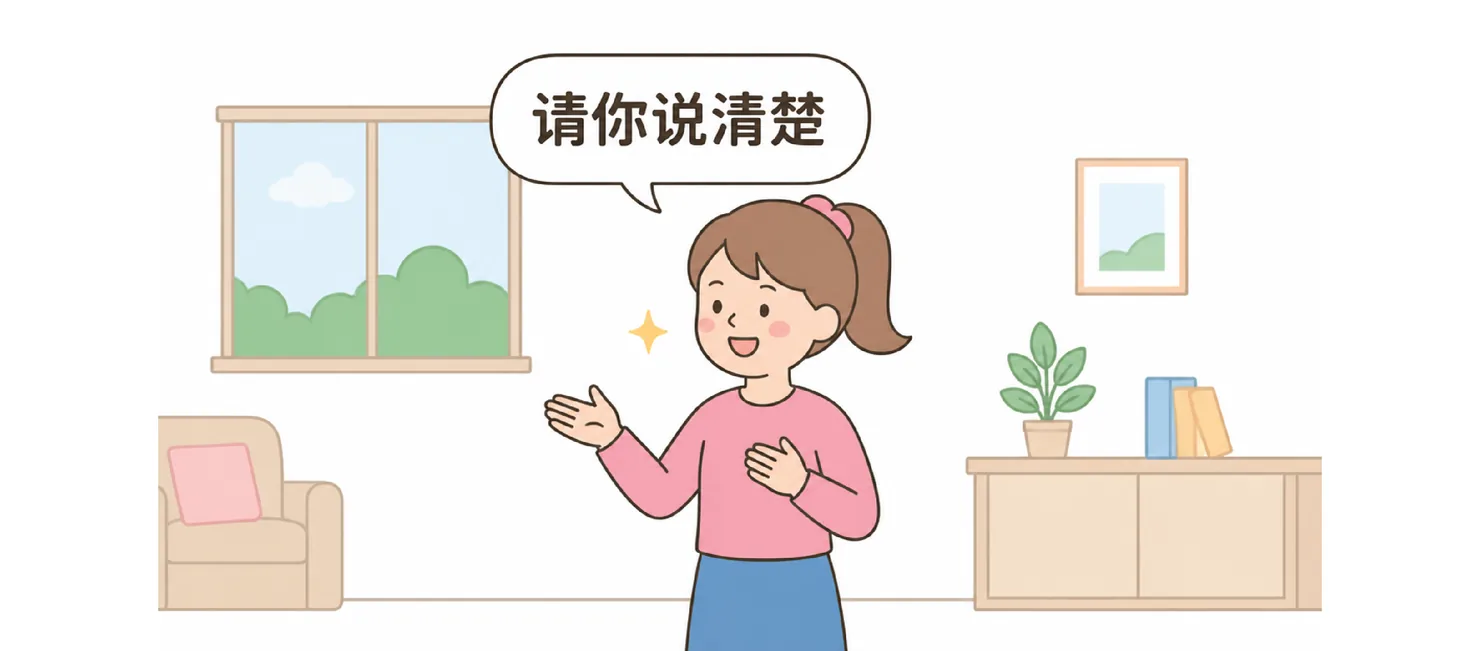 请你说清楚 — “Please say it clearly.”
Key rule: 清楚 attaches directly to the verb, exactly like a one-syllable complement — its extra syllable changes nothing about the grammar.
What 清楚 Adds to the Verb
| Without 清楚 | Pinyin | With 清楚 | Pinyin | Difference |
|---|---|---|---|---|
| 我看了。 | Wǒ kàn le. | 我看清楚了。 | Wǒ kàn qīngchǔ le. | looked vs. saw clearly |
| 他说了。 | Tā shuō le. | 他说清楚了。 | Tā shuō qīngchǔ le. | spoke vs. expressed it clearly |
The Five Shades of 清楚
| Shade | What it means | Example |
|---|---|---|
| Visual clarity | seeing something distinctly | 看清楚 kàn qīngchǔ — see clearly |
| Auditory clarity | hearing something distinctly | 听清楚 tīng qīngchǔ — hear clearly |
| Verbal clarity | expressing something clearly | 说清楚 shuō qīngchǔ — explain clearly |
| Mental clarity | thinking something through | 想清楚 xiǎng qīngchǔ — figure out |
| Written clarity | writing something legibly | 写清楚 xiě qīngchǔ — write clearly |
Which Verbs Pair with 清楚
| Verb + 清楚 | Pinyin | English |
|---|---|---|
| 看清楚 | kàn qīngchǔ | see clearly / read clearly |
| 听清楚 | tīng qīngchǔ | hear clearly |
| 说清楚 | shuō qīngchǔ | say clearly / explain clearly |
| 想清楚 | xiǎng qīngchǔ | think through / figure out |
| 写清楚 | xiě qīngchǔ | write clearly / state clearly |
| 问清楚 | wèn qīngchǔ | ask until it’s clear |
Compatibility: 清楚 attaches to verbs of perception and communication. Actions that cannot produce clarity are blocked — ❌ 吃清楚 (chī qīngchǔ), ❌ 跑清楚 (pǎo qīngchǔ).
Core Examples
| Chinese | Pinyin | English | Context |
|---|---|---|---|
| 请你说清楚。 | Qǐng nǐ shuō qīngchǔ. | Please say it clearly. | asking for clarity |
| 我没听清楚。 | Wǒ méi tīng qīngchǔ. | I didn’t hear it clearly. | unclear audio |
| 你看清楚了吗? | Nǐ kàn qīngchǔ le ma? | Did you see it clearly? | visual clarity |
| 我想清楚了。 | Wǒ xiǎng qīngchǔ le. | I’ve thought it through. | mental clarity |
| 请把地址写清楚。 | Qǐng bǎ dìzhǐ xiě qīngchǔ. | Please write the address clearly. | written clarity |
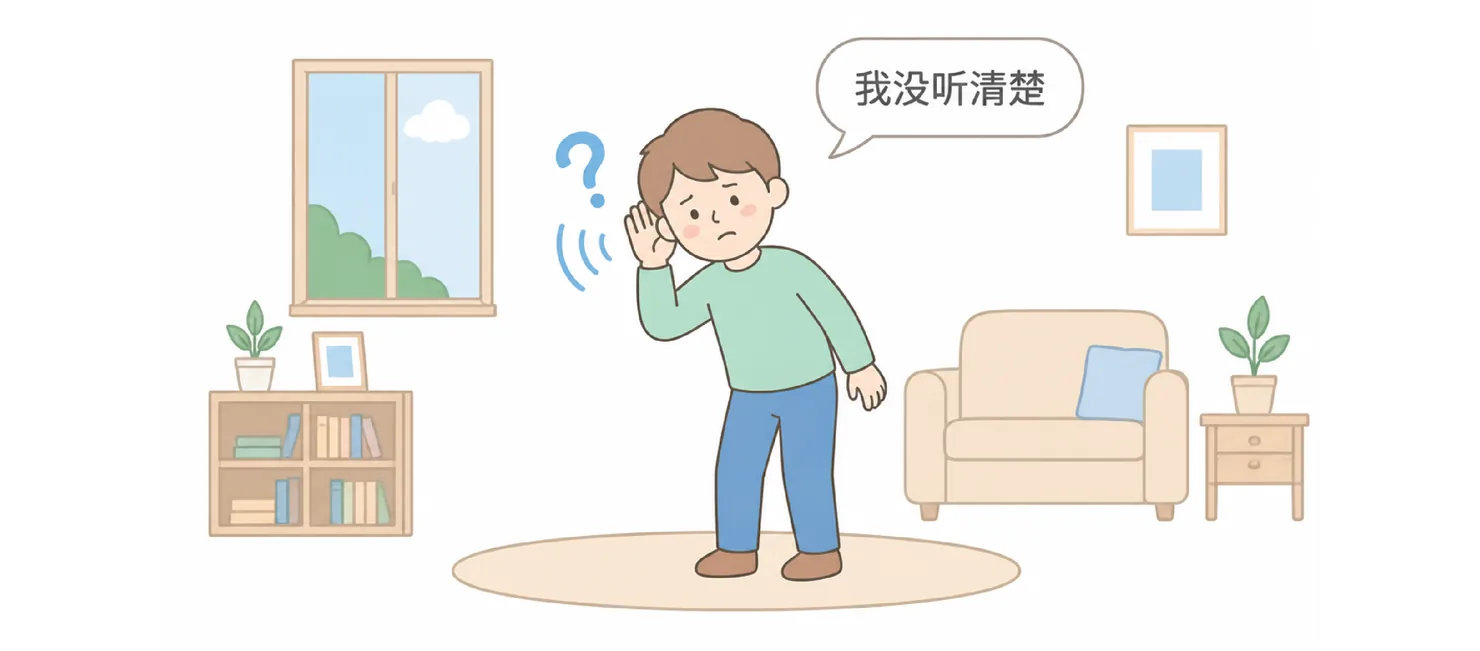 我没听清楚 — “I didn’t hear it clearly.” One of the most useful phrases for a learner.
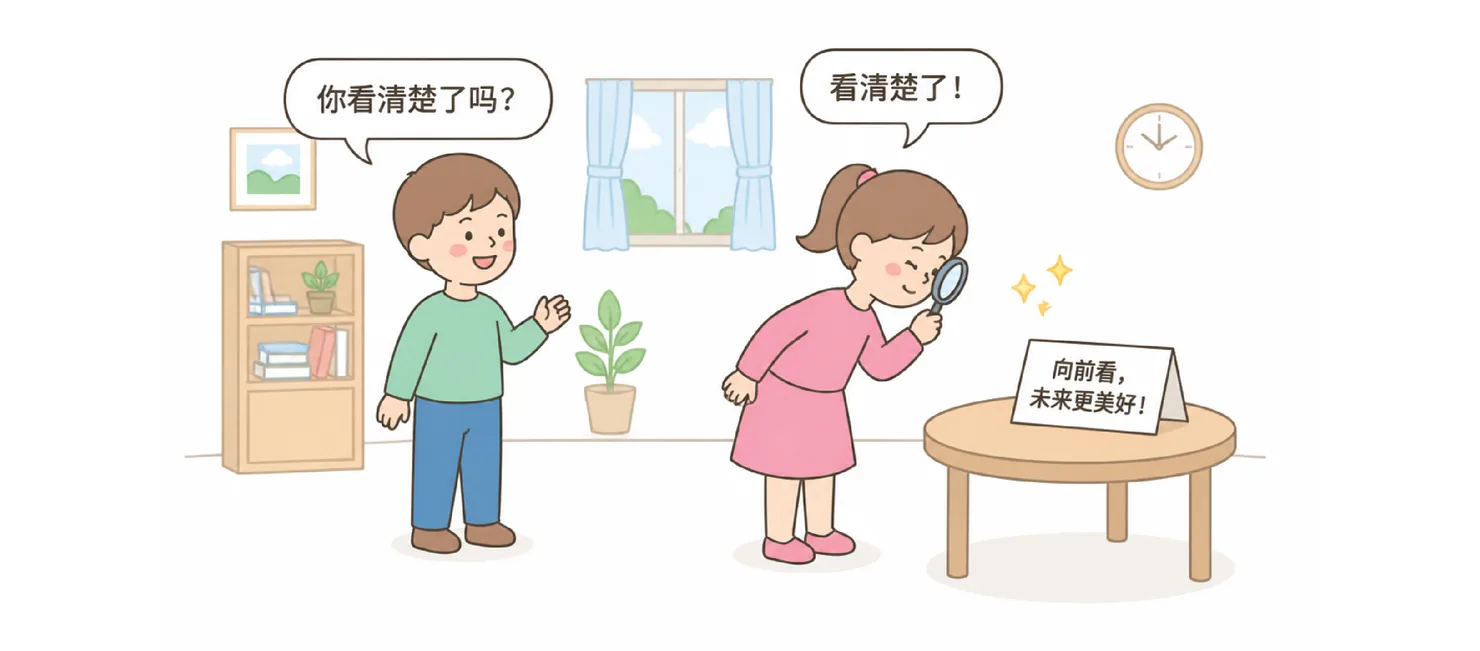 你看清楚了吗?— 看清楚了!“Did you see it clearly?” — “I saw it clearly!”
Nuance 1 — 清楚 vs. 懂: Clarity vs. Comprehension
This is the distinction that matters most. 清楚 is about the signal arriving distinctly — you caught the sounds or saw the shapes. 懂 is about understanding the meaning. You can hear something perfectly clearly and still not understand a word of it, which is exactly the situation every language learner knows.
清楚 = you perceived it distinctly. 懂 = you understood its meaning. They are different things.
| Complement | What succeeded | Chinese | Pinyin | English |
|---|---|---|---|---|
| 清楚 | the signal was distinct | 我听清楚了,但是没听懂。 | Wǒ tīng qīngchǔ le, dànshì méi tīng dǒng. | I heard it clearly, but didn’t understand it. |
| 懂 | the meaning was grasped | 我听懂了。 | Wǒ tīng dǒng le. | I understood it. |
Nuance 2 — 清楚 in Everyday Requests
清楚 is the natural way to ask someone to repeat themselves or to be more precise — far more useful in daily life than its grammar suggests.
清楚 is how you ask someone to repeat or be clearer.
| Chinese | Pinyin | English |
|---|---|---|
| 你能说清楚一点儿吗? | Nǐ néng shuō qīngchǔ yīdiǎnr ma? | Could you say that a bit more clearly? |
| 对不起,我没听清楚。 | Duìbuqǐ, wǒ méi tīng qīngchǔ. | Sorry, I didn’t catch that clearly. |
| 你能把这件事说清楚吗? | Nǐ néng bǎ zhè jiàn shì shuō qīngchǔ ma? | Can you explain this matter clearly? |
Nuance 3 — Nothing Comes Between the Verb and 清楚
| Chinese | Pinyin | English | |
|---|---|---|---|
| ✅ Correct | 我看清楚了。 | Wǒ kàn qīngchǔ le. | I saw it clearly. |
| ❌ Incorrect | 我看了清楚。 | Wǒ kàn le qīngchǔ. | 了 cannot separate 看 and 清楚. |
Negation — Use 没, Not 不
| Chinese | Pinyin | English | |
|---|---|---|---|
| ✅ Correct | 她没看清楚。 | Tā méi kàn qīngchǔ. | She didn’t see it clearly. |
| ❌ Incorrect | 她不看清楚。 | Tā bù kàn qīngchǔ. | 没 is for completed actions, not 不. |
The one place 不 appears: the potential form — 听不清楚 (tīng bu qīngchǔ, can’t hear clearly), 看不清楚 (kàn bu qīngchǔ, can’t see clearly). Positive: 看得清楚 (kàn de qīngchǔ, can see clearly).
Quick Reference
| Point | Summary |
|---|---|
| Meaning | 清楚 = the action produced clarity |
| Form | two syllables, but grammatically identical to 完/到/懂 |
| Attachment | directly after the verb — nothing in between |
| Negation | 没 for completed actions; 不 only in the potential form |
| 清楚 vs 懂 | 清楚 = perceived distinctly · 懂 = understood the meaning |
| Common verbs | 说, 听, 看, 想, 写, 问 |
Drills
Fill in the correct result complement. Choose from 清楚 / 懂 / 见 / 完. Each question’s English meaning is the hint.
- 请你说___。(Please say it clearly.)
- 我没听___。(I didn’t hear it clearly.)
- 你看___了吗?(Did you see it clearly?)
- 我想___了。(I’ve thought it through.)
- 请把地址写___。(Please write the address clearly.)
- 你能把这件事说___吗?(Can you explain this clearly?)
- 你要先问___再决定。(Ask until it’s clear before deciding.)
- 你听___了吗?(Did you understand by listening?)
- 我看___了这篇文章。(I understood this article.)
- 我听___有人在唱歌。(I hear someone singing.)
- 你看___他了吗?(Did you see him?)
- 作业做___了吗?(Have you finished your homework?)
Answer Key: 1. 清楚 2. 清楚 3. 清楚 4. 清楚 5. 清楚 6. 清楚 7. 清楚 8. 懂 9. 懂 10. 见 11. 见 12. 完
Notes
- Common V+清楚 chunks: 看清楚, 听清楚, 说清楚, 想清楚, 写清楚, 问清楚.
- 我没听清楚 is arguably the most practical sentence on this page — use it whenever you miss something.
- 清楚 also works as an ordinary adjective (“clear”), e.g. 这张照片很清楚 (Zhè zhāng zhàopiàn hěn qīngchǔ — “This photo is very clear”).
- For understanding rather than clarity, see 懂; for the whole family see result complements.
Sources
HSK Standard Course 3 — 结果补语 (清楚) HSK Standard Course 2 — L9 (结果补语, result complements introduced) HSK Standard Course 3 — L6 (V得/不 + RC, potential form)