懂 as a Result Complement — Understand
Overview
懂 (dǒng) is a result complement showing that comprehension was achieved through a specific act of perceiving or studying. When you attach 懂 to a verb, you are saying the action produced understanding — the information was received and its meaning grasped. 听懂 is "understand by listening," 看懂 is "understand by reading or watching," 学懂 is "learn and understand." The important structural point: in this meaning 懂 is a result complement, not a standalone verb — the full form is always V + 懂, which also tells the listener how you understood.
懂 (dǒng) says an act of perceiving or studying produced understanding: 听懂 (by listening), 看懂 (by reading/watching). Always V + 懂.
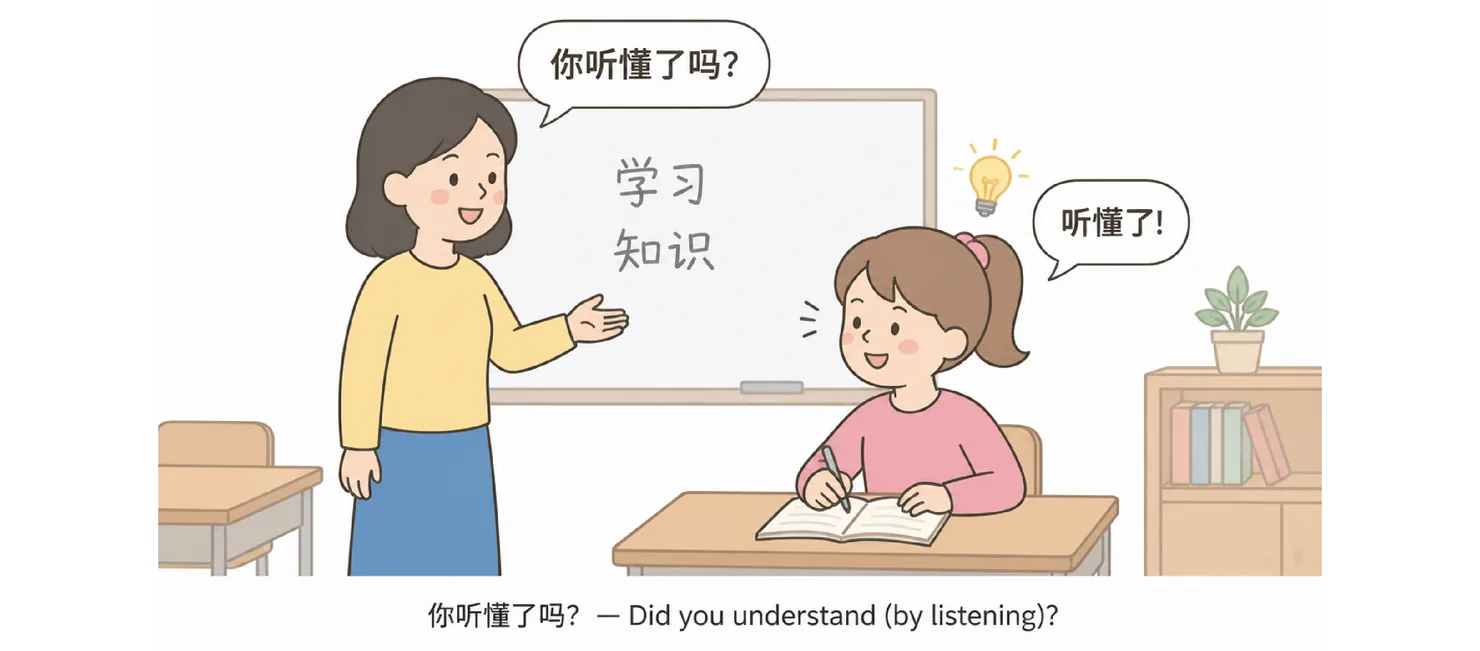 你听懂了吗?— 听懂了!“Did you understand (by listening)?” — “Understood!”
Key rule: 懂 attaches directly to the verb, and the verb tells you the channel — ears (听懂), eyes (看懂), study (学懂).
What 懂 Adds to the Verb
| Without 懂 | Pinyin | With 懂 | Pinyin | Difference |
|---|---|---|---|---|
| 我听他说。 | Wǒ tīng tā shuō. | 我听懂他说什么了。 | Wǒ tīng dǒng tā shuō shénme le. | listening vs. understood |
| 我看这篇文章。 | Wǒ kàn zhè piān wénzhāng. | 我看懂这篇文章了。 | Wǒ kàn dǒng zhè piān wénzhāng le. | reading vs. understood |
Which Verbs Pair with 懂
懂 attaches to verbs of perception and learning. Each pairing names the channel through which understanding arrived.
懂 pairs with perception and learning verbs; each names how you understood.
| Verb + 懂 | Pinyin | English |
|---|---|---|
| 听懂 | tīng dǒng | understand (by listening) |
| 看懂 | kàn dǒng | understand (by reading / watching) |
| 学懂 | xué dǒng | learn and understand (by studying) |
| 读懂 | dú dǒng | understand (by reading carefully) |
| 弄懂 | nòng dǒng | figure out / make sense of |
Compatibility: 懂 only works with verbs that involve receiving or processing information. It does not attach to physical actions — ❌ 跑懂 (pǎo dǒng), ❌ 吃懂 (chī dǒng) — since running and eating produce no comprehension.
Core Examples
| Chinese | Pinyin | English | Context |
|---|---|---|---|
| 你听懂了吗? | Nǐ tīng dǒng le ma? | Did you understand (by listening)? | after an explanation |
| 我看懂了这篇文章。 | Wǒ kàn dǒng le zhè piān wénzhāng. | I understood this article. | reading comprehension |
| 他说得太快,我没听懂。 | Tā shuō de tài kuài, wǒ méi tīng dǒng. | He spoke too fast; I didn’t understand. | failed listening |
| 这个语法点我学懂了。 | Zhège yǔfǎ diǎn wǒ xué dǒng le. | I’ve learned and understood this grammar point. | successful study |
| 你弄懂这道题了吗? | Nǐ nòng dǒng zhè dào tí le ma? | Did you figure out this problem? | problem-solving |
 我看懂了这篇文章 — “I understood this article.” The 看 tells you it came through reading.
Nuance 1 — 听懂 vs. 看懂
These are by far the two most common 懂 pairings, and the choice is decided by how the information reached you: through the ears or through the eyes.
听懂 = understood by hearing. 看懂 = understood by reading or watching.
| Complement | Channel | Chinese | Pinyin | English |
|---|---|---|---|---|
| 听懂 | hearing (speech, audio) | 我听懂了他的话。 | Wǒ tīng dǒng le tā de huà. | I understood his words. |
| 看懂 | reading / watching (text, video) | 我看懂了这部电影。 | Wǒ kàn dǒng le zhè bù diànyǐng. | I understood this movie. |
Nuance 2 — 懂 vs. 明白
Both translate as "understand," but they work differently. 懂 is a result complement attached to a verb, specifying how comprehension happened. 明白 is a standalone verb for general understanding or a situation becoming clear.
懂 attaches to a verb (how you understood); 明白 stands alone (general clarity).
| Word | Type | Meaning | Chinese | Pinyin | English |
|---|---|---|---|---|---|
| 懂 | result complement | comprehension via a specific action | 我听懂了。 | Wǒ tīng dǒng le. | I understood (by listening). |
| 明白 | standalone verb | general understanding / clarity | 我明白了。 | Wǒ míngbai le. | I understand / I see now. |
Rule of thumb: use V+懂 to specify how you understood; use 明白 for general clarity about a situation.
Nuance 3 — 懂 Needs Its Verb
In this meaning 懂 is not a standalone verb. The complete form is V + 懂, which names the channel. In casual speech 我懂了 does occur as "I get it" when the channel is obvious from context, but at HSK 2–3 the full V+懂 form is safer and clearer.
Use the full V+懂 form; bare 我懂了 only works when context makes the channel obvious.
| Chinese | Pinyin | English | |
|---|---|---|---|
| ✅ Clear | 我听懂了。 | Wǒ tīng dǒng le. | I understood (by listening). |
| ⚠️ Vague | 我懂了。 | Wǒ dǒng le. | I get it. — only if the channel is clear from context. |
Nuance 4 — Nothing Comes Between the Verb and 懂
| Chinese | Pinyin | English | |
|---|---|---|---|
| ✅ Correct | 我听懂了。 | Wǒ tīng dǒng le. | I understood what I heard. |
| ❌ Incorrect | 我听了懂。 | Wǒ tīng le dǒng. | 了 cannot separate 听 and 懂. |
| Chinese | Pinyin | English | |
|---|---|---|---|
| ✅ Correct | 他看懂了。 | Tā kàn dǒng le. | He understood it (by reading). |
| ❌ Incorrect | 他看了懂。 | Tā kàn le dǒng. | 了 cannot separate 看 and 懂. |
Negation — Use 没, Not 不
| Chinese | Pinyin | English | |
|---|---|---|---|
| ✅ Correct | 我没听懂。 | Wǒ méi tīng dǒng. | I didn’t understand (what I heard). |
| ❌ Incorrect | 我不听懂。 | Wǒ bù tīng dǒng. | 没 is for completed actions, not 不. |
| Chinese | Pinyin | English | |
|---|---|---|---|
| ✅ Correct | 他没看懂。 | Tā méi kàn dǒng. | He didn’t understand it (by reading). |
| ❌ Incorrect | 他不看懂。 | Tā bù kàn dǒng. | 没 is for completed actions, not 不. |
The one place 不 appears: the potential form — 听不懂 (tīng bu dǒng, cannot understand by listening), 看不懂 (kàn bu dǒng, cannot understand by reading). Positive: 听得懂 (tīng de dǒng, can understand).
Quick Reference
| Point | Summary |
|---|---|
| Meaning | 懂 = comprehension achieved through a specific action |
| Attachment | directly after the verb — nothing in between |
| Object position | after the V+懂 pair |
| Negation | 没 for completed actions; 不 only in the potential form |
| 懂 vs 明白 | 懂 = comprehension via an action · 明白 = general understanding |
| 听懂 vs 看懂 | by hearing · by reading or watching |
| Common verbs | 听, 看, 学, 读, 弄 |
Drills
Fill in the correct result complement. Choose from 懂 / 清楚 / 到 / 完. Each question’s English meaning is the hint.
- 你听___了吗?(Did you understand by listening?)
- 我看___了这篇文章。(I understood this article.)
- 他说得太快,我没听___。(He spoke too fast; I didn’t understand.)
- 这个语法点我学___了。(I’ve learned and understood this grammar point.)
- 你弄___这道题了吗?(Did you figure out this problem?)
- 他看___中文新闻了吗?(Did he understand the Chinese news by reading?)
- 我没听___老师的话。(I didn’t understand the teacher’s words.)
- 这篇文章我读___了。(I understood the article by careful reading.)
- 请你说___,我听不见。(Please say it clearly.)
- 我没看___黑板上的字。(I couldn’t see the words on the board clearly.)
- 我找___钥匙了。(I found the keys.)
- 作业做___了吗?(Have you finished your homework?)
Answer Key: 1. 懂 2. 懂 3. 懂 4. 懂 5. 懂 6. 懂 7. 懂 8. 懂 9. 清楚 10. 清楚 11. 到 12. 完
Notes
- Common V+懂 chunks worth memorising: 听懂, 看懂, 学懂, 读懂, 弄懂.
- 懂 requires an information-processing verb — it cannot follow physical actions like 跑 or 吃.
- 没听懂 is one of the most useful phrases for a learner: “I didn’t catch that.”
- For clarity of perception rather than comprehension, see 清楚; for the whole family, see result complements.
Sources
HSK Standard Course 2 — L9 (结果补语, result complements introduced) HSK Standard Course 3 — L6 (V得/不 + RC, potential form)