到 as a Result Complement — Reach / Succeed In
Overview
到 (dào) is a result complement telling the listener that an action successfully reached its goal — the search succeeded, the purchase went through, the sound was perceived. It corresponds to English "reach," "find," "get," or "manage to." 找到 is 找 (look for) plus success; 买到 is 买 (buy) plus success; 听到 is 听 (listen) plus successful perception. The key idea: 到 does not merely say the action happened, it says the action hit its target. This is why 我找钥匙 cannot mean "I found the keys" — without 到 you are only describing the looking.
到 (dào) says the action reached its goal — found, got, successfully perceived. Without it, you've only described the attempt.
 你找到钥匙了吗?— 找到了!“Did you find the keys?” — “Found them!”
Key rule: 到 attaches directly to the verb. To say the action failed, use 没 + V + 到: 没找到 (didn’t find), 没买到 (couldn’t get), 没看到 (didn’t see).
What 到 Adds to the Verb
Without 到 the sentence reports an activity; with 到 it reports a success. This contrast is the whole point of the complement.
Without 到 = the attempt; with 到 = the success.
| Without 到 | Pinyin | With 到 | Pinyin | Difference |
|---|---|---|---|---|
| 我找钥匙。 | Wǒ zhǎo yàoshi. | 我找到钥匙了。 | Wǒ zhǎo dào yàoshi le. | searching vs. found |
| 我买票了。 | Wǒ mǎi piào le. | 我买到票了。 | Wǒ mǎi dào piào le. | bought/tried vs. successfully got |
| 我听广播。 | Wǒ tīng guǎngbō. | 我听到广播了。 | Wǒ tīng dào guǎngbō le. | listening vs. actually heard |
The Five Shades of 到
| Shade | What it means | Example |
|---|---|---|
| Finding / locating | successfully locating after searching | 找到 zhǎo dào — find; 遇到 yù dào — run into |
| Acquiring | successfully getting something | 买到 mǎi dào — manage to buy; 得到 dé dào — obtain |
| Perceiving | successfully perceiving with the senses | 看到 kàn dào — see; 听到 tīng dào — hear |
| Receiving | successfully receiving something | 收到 shōu dào — receive |
| Realizing | successfully thinking of something | 想到 xiǎng dào — think of |
Which Verbs Pair with 到
| Verb + 到 | Pinyin | English | Verb + 到 | Pinyin | English |
|---|---|---|---|---|---|
| 找到 | zhǎo dào | find | 买到 | mǎi dào | manage to buy |
| 看到 | kàn dào | see / catch sight of | 听到 | tīng dào | hear |
| 收到 | shōu dào | receive | 得到 | dé dào | obtain / get |
| 遇到 | yù dào | encounter / run into | 想到 | xiǎng dào | think of / come up with |
Compatibility: 到 needs a verb with a clear goal or target. It does not attach to continuous states — ❌ 喜欢到 (xǐhuān dào), ❌ 知道到 (zhīdào dào) — because these have no target to reach.
Core Examples
| Chinese | Pinyin | English | Context |
|---|---|---|---|
| 你找到钥匙了吗? | Nǐ zhǎo dào yàoshi le ma? | Did you find the keys? | successful search |
| 我买到票了! | Wǒ mǎi dào piào le! | I managed to get tickets! | successful purchase |
| 没听到,再说一遍。 | Méi tīng dào, zài shuō yī biàn. | I didn’t hear it — say it again. | failed perception |
| 我没想到你会来。 | Wǒ méi xiǎng dào nǐ huì lái. | I didn’t expect you would come. | unexpected outcome |
| 他收到了很多礼物。 | Tā shōu dào le hěnduō lǐwù. | He received many gifts. | successful receipt |
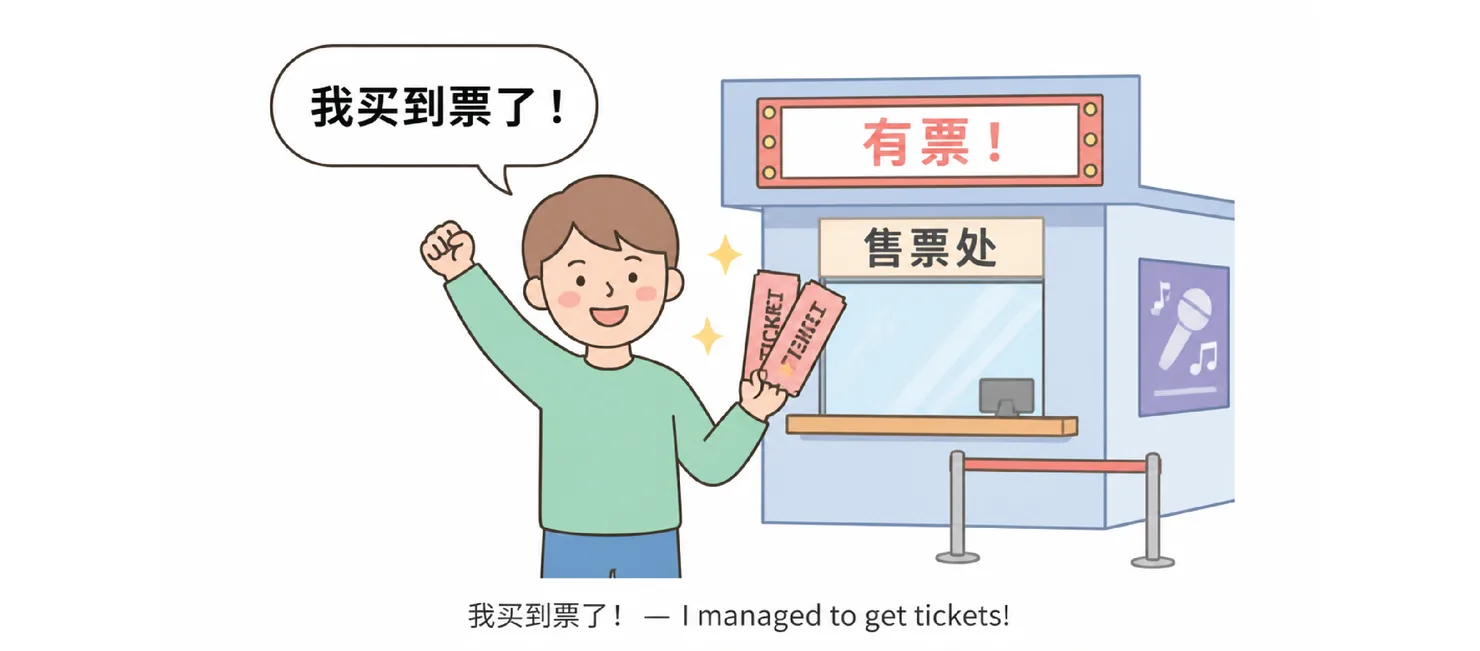 我买到票了!— “I managed to get tickets!” The 到 marks the success, not just the attempt.
 他收到了很多礼物 — “He received many gifts.”
Nuance 1 — 到 vs. 见: Two Ways to “See”
Both 到 and 见 attach to perception verbs like 看 and 听, and in practice they are often interchangeable. The difference in emphasis: 到 highlights the successful outcome (the action reached its target), while 见 highlights the sensory act itself (your eyes or ears perceived it).
到 stresses succeeding at perceiving; 见 stresses the sensory act. Often interchangeable.
| Complement | Emphasis | Chinese | Pinyin | English |
|---|---|---|---|---|
| 到 | successful outcome | 我看到他了。 | Wǒ kàn dào tā le. | I saw him. (I succeeded in seeing him) |
| 见 | the sensory act | 我看见他了。 | Wǒ kàn jiàn tā le. | I saw him. (my eyes perceived him) |
| Situation | Better choice | Why |
|---|---|---|
| You searched for someone and found them | 看到 | emphasizes the successful search |
| You saw someone unexpectedly | 看见 | emphasizes the sensory act |
| You actively looked for something | 看到 | emphasizes the successful outcome |
| You caught a glimpse of something | 看见 | emphasizes the sensory act |
Nuance 2 — 到 vs. 完: Target vs. Completion
Both say something about an endpoint, but 完 is about finishing the whole quantity, while 到 is about hitting the target.
完 = the whole thing is finished; 到 = the goal was reached.
| Complement | Focus | Chinese | Pinyin | English |
|---|---|---|---|---|
| 完 | completion — nothing left | 我吃完了。 | Wǒ chī wán le. | I finished eating. |
| 到 | reaching the target | 我买到了。 | Wǒ mǎi dào le. | I managed to buy it. |
Nuance 3 — Nothing Comes Between the Verb and 到
| Chinese | Pinyin | English | |
|---|---|---|---|
| ✅ Correct | 我找到钥匙了。 | Wǒ zhǎo dào yàoshi le. | I found the key. |
| ❌ Incorrect | 我找了到钥匙。 | Wǒ zhǎo le dào yàoshi. | 了 cannot separate 找 and 到. |
| Chinese | Pinyin | English | |
|---|---|---|---|
| ✅ Correct | 我听到声音了。 | Wǒ tīng dào shēngyīn le. | I heard the sound. |
| ❌ Incorrect | 我听了到声音。 | Wǒ tīng le dào shēngyīn. | 了 cannot separate 听 and 到. |
Negation — Use 没, Not 不
| Chinese | Pinyin | English | |
|---|---|---|---|
| ✅ Correct | 我没找到钥匙。 | Wǒ méi zhǎo dào yàoshi. | I didn’t find the key. |
| ❌ Incorrect | 我不找到钥匙。 | Wǒ bù zhǎo dào yàoshi. | 没 is for completed actions, not 不. |
| Chinese | Pinyin | English | |
|---|---|---|---|
| ✅ Correct | 他没买到票。 | Tā méi mǎi dào piào. | He didn’t manage to buy a ticket. |
| ❌ Incorrect | 他不买到票。 | Tā bù mǎi dào piào. | 没 is for completed actions, not 不. |
The one place 不 appears: the potential form — 找不到 (zhǎo bu dào, cannot find), 买不到 (mǎi bu dào, cannot get), 听不到 (tīng bu dào, cannot hear). Positive: 找得到 (zhǎo de dào, can find).
Quick Reference
| Point | Summary |
|---|---|
| Meaning | 到 = reach / succeed / achieve the goal |
| Attachment | directly after the verb — nothing in between |
| Object position | after the V+到 pair |
| Negation | 没 for completed actions; 不 only in the potential form |
| 到 vs 见 | 到 = successful outcome · 见 = the sensory act itself |
| Common verbs | 找, 买, 看, 听, 收, 得, 遇, 想 |
Drills
Fill in the correct result complement. Choose from 到 / 完 / 好 / 见. Each question’s English meaning is the hint.
- 你找___钥匙了吗?(Did you find the keys?)
- 我买___票了!(I managed to get tickets!)
- 没听___,再说一遍。(I didn’t hear it — say it again.)
- 我没想___你会来。(I didn’t expect you would come.)
- 他收___了很多礼物。(He received many gifts.)
- 你在哪儿遇___他的?(Where did you run into him?)
- 我没找___我的钱包。(I didn’t find my wallet.)
- 我吃___饭了。(I finished eating.)
- 票都卖___了。(The tickets are all sold out.)
- 饭已经做___了。(The meal is ready.)
- 我听___有人在唱歌。(I hear someone singing — sensory perception.)
- 你准备___了吗?(Are you ready?)
Answer Key: 1. 到 2. 到 3. 到 4. 到 5. 到 6. 到 7. 到 8. 完 9. 完 10. 好 11. 见 12. 好
Notes
- Common V+到 chunks worth memorising: 找到, 看到, 听到, 买到, 收到, 得到, 遇到, 想到.
- 没想到 (“didn’t expect”) is an extremely common fixed expression for surprise.
- 到 needs a target — it cannot attach to states like 喜欢 or 知道.
- For the whole complement family and how they compare, see result complements.
Sources
HSK Standard Course 2 — L9 (结果补语, result complements introduced) HSK Standard Course 3 — L6 (V得/不 + RC, potential form)