完 as a Result Complement — Finish / Complete
Overview
完 (wán) is one of the most frequently used result complements in Chinese. It tells the listener that an action has been fully completed — the action reached its natural end point and nothing remains to be done. It corresponds to English "finish," "complete," or the particle "up" as in "eat up" and "use up." Unlike English, where completion is often left to context, Chinese requires 完 whenever you want to state explicitly that an action is finished. The key idea: 完 does not merely say the action happened — it says the action is done, with nothing left.
完 (wán) says an action is fully finished — nothing left to do. English "finish," "complete," or "up" as in "eat up."
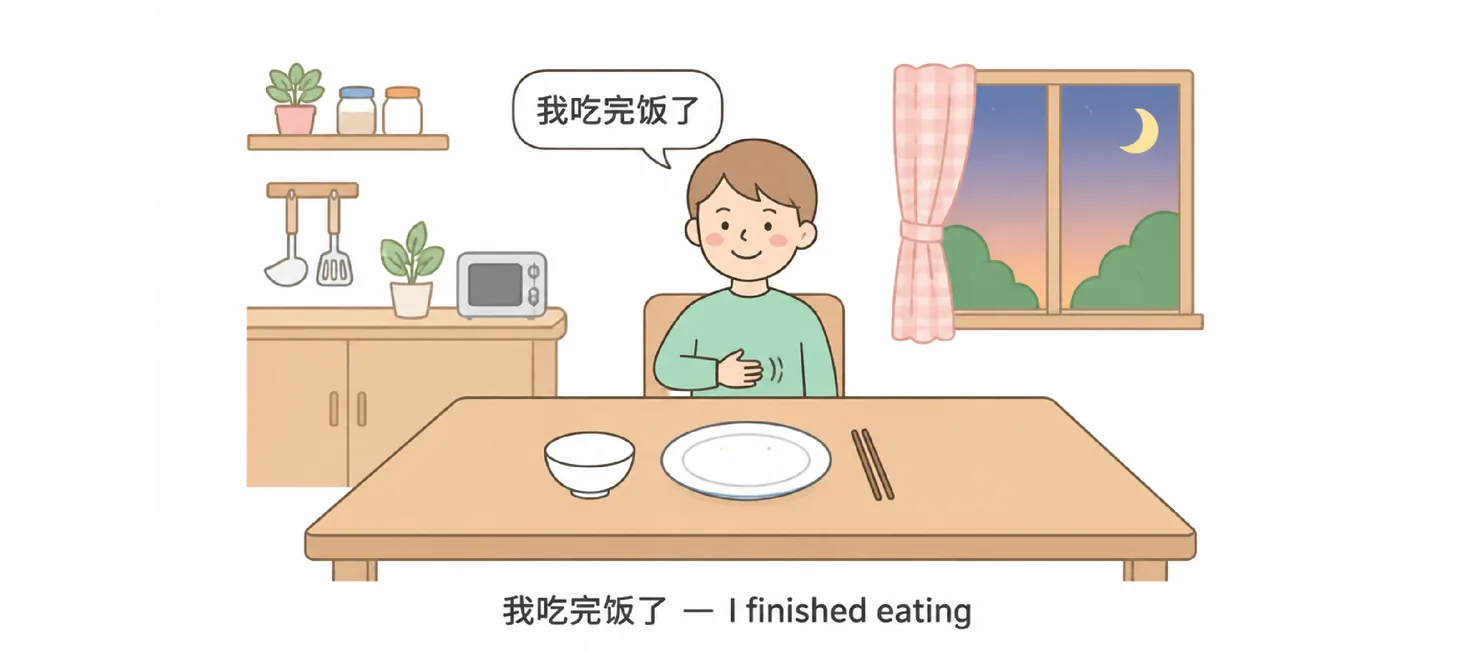 我吃完饭了 — “I finished eating.” The empty plate is the result 完 expresses.
Key rule: 完 attaches directly to the verb. The object goes after the V+完 pair, and 了 goes after that — never between the verb and 完.
The Three Shades of 完
完 carries three related but distinct ideas depending on the verb it attaches to. In every case the underlying logic is identical — the action reached its end point — but what "ends" differs: something is consumed, something is created, or a supply runs out.
完 covers three related ideas: something consumed, something created/processed, or a supply depleted.
| Shade | What it means | Examples |
|---|---|---|
| Consumption | Something is fully consumed | 吃完 chī wán (finish eating), 喝完 hē wán (finish drinking), 用完 yòng wán (finish using) |
| Creation / processing | Something is fully made or worked through | 写完 xiě wán (finish writing), 做完 zuò wán (finish doing), 画完 huà wán (finish drawing) |
| Depletion | A supply or quantity is exhausted | 卖完 mài wán (sell out), 用完 yòng wán (used up), 花完 huā wán (spent) |
Which Verbs Pair with 完
完 attaches to almost any action verb involving consuming, creating, processing, or handling something. What matters is that the verb has a clear end point.
完 pairs with action verbs that have a clear end point.
| Verb + 完 | Pinyin | English | Verb + 完 | Pinyin | English |
|---|---|---|---|---|---|
| 吃完 | chī wán | finish eating | 看完 | kàn wán | finish watching / reading |
| 写完 | xiě wán | finish writing | 做完 | zuò wán | finish doing |
| 喝完 | hē wán | finish drinking | 用完 | yòng wán | finish using |
| 买完 | mǎi wán | finish buying | 卖完 | mài wán | sell out |
| 读完 | dú wán | finish reading | 讲完 | jiǎng wán | finish speaking / explaining |
| 洗完 | xǐ wán | finish washing | 收拾完 | shōushi wán | finish tidying up |
Compatibility: 完 needs a verb with a natural finish line. It does not attach to continuous states or feelings — ❌ 喜欢完 (xǐhuān wán), ❌ 知道完 (zhīdào wán) — because liking and knowing have no completion point.
Core Examples
| Chinese | Pinyin | English | Context |
|---|---|---|---|
| 我吃完饭了。 | Wǒ chī wán fàn le. | I finished eating. | after a meal |
| 作业做完了吗? | Zuòyè zuò wán le ma? | Have you finished your homework? | asking about completion |
| 他没看完那本书。 | Tā méi kàn wán nà běn shū. | He didn’t finish reading that book. | negation with 没 |
| 票都卖完了。 | Piào dōu mài wán le. | The tickets are all sold out. | depletion |
| 你吃完药再睡觉。 | Nǐ chī wán yào zài shuìjiào. | Take your medicine first, then sleep. | sequential actions |
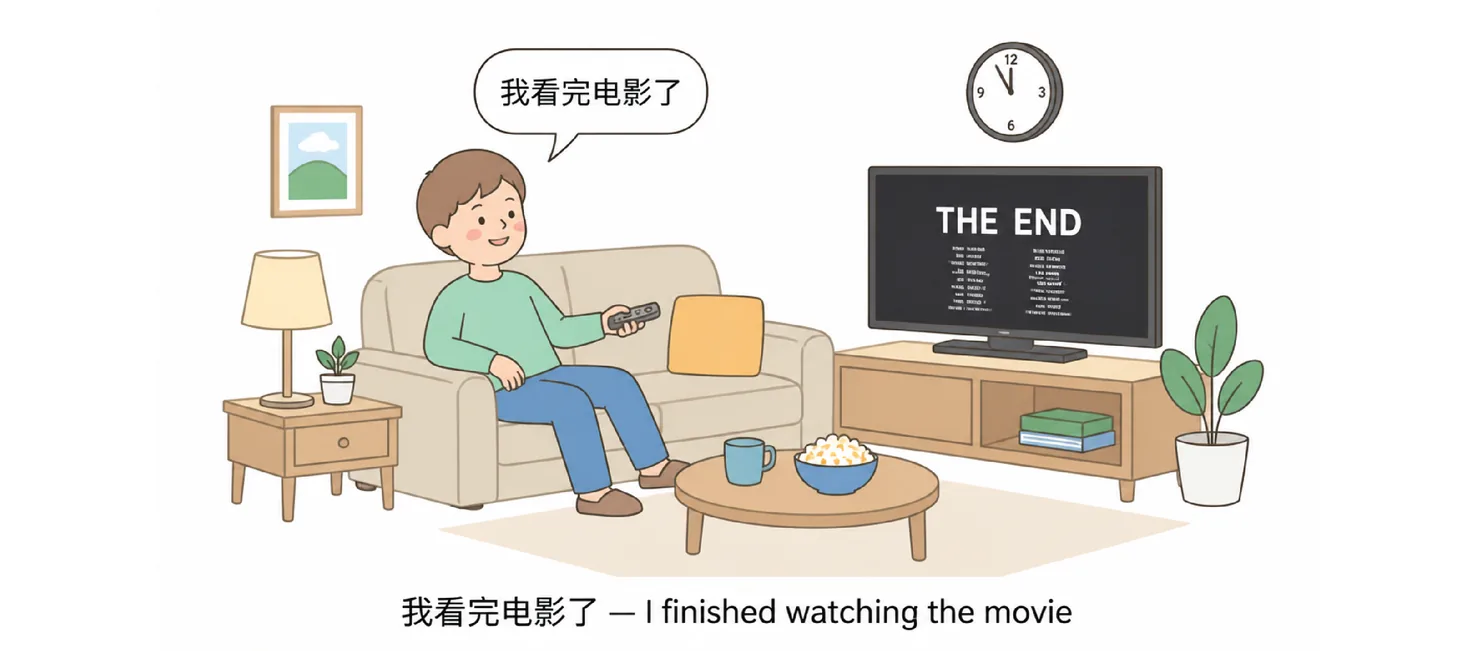 我看完电影了 — “I finished watching the movie.”
 作业做完了吗?— 做完了!“Have you finished your homework?” — “Finished!”
Nuance 1 — 完 Marks the End, Not the Quality
完 tells the listener the action is finished, not that it was done well. If you want to say something was completed properly and is now ready, use 好 instead. This is the single most useful contrast to learn alongside 完.
完 = it's finished. 好 = it's done properly and ready. Different focus.
| Complement | Focus | Chinese | Pinyin | English |
|---|---|---|---|---|
| 完 | completion — you reached the end | 我写完了。 | Wǒ xiě wán le. | I finished writing. |
| 好 | satisfactory state — it’s ready | 我写好了。 | Wǒ xiě hǎo le. | I’ve written it properly / it’s ready. |
Rule of thumb: for the plain fact that homework is done, use 完. For “my homework is ready / done properly,” use 好.
Nuance 2 — 完 Can Mean “Used Up”
With verbs like 卖 (sell), 用 (use), and 花 (spend), 完 signals that a supply is exhausted — everything is gone. This is extremely common in daily conversation, especially the shop-front 卖完了 ("sold out").
With 卖, 用, 花, the 完 means a supply has run out entirely.
| Chinese | Pinyin | English |
|---|---|---|
| 票卖完了。 | Piào mài wán le. | The tickets are sold out. |
| 水用完了。 | Shuǐ yòng wán le. | The water is used up. |
| 钱花完了。 | Qián huā wán le. | The money is all spent. |
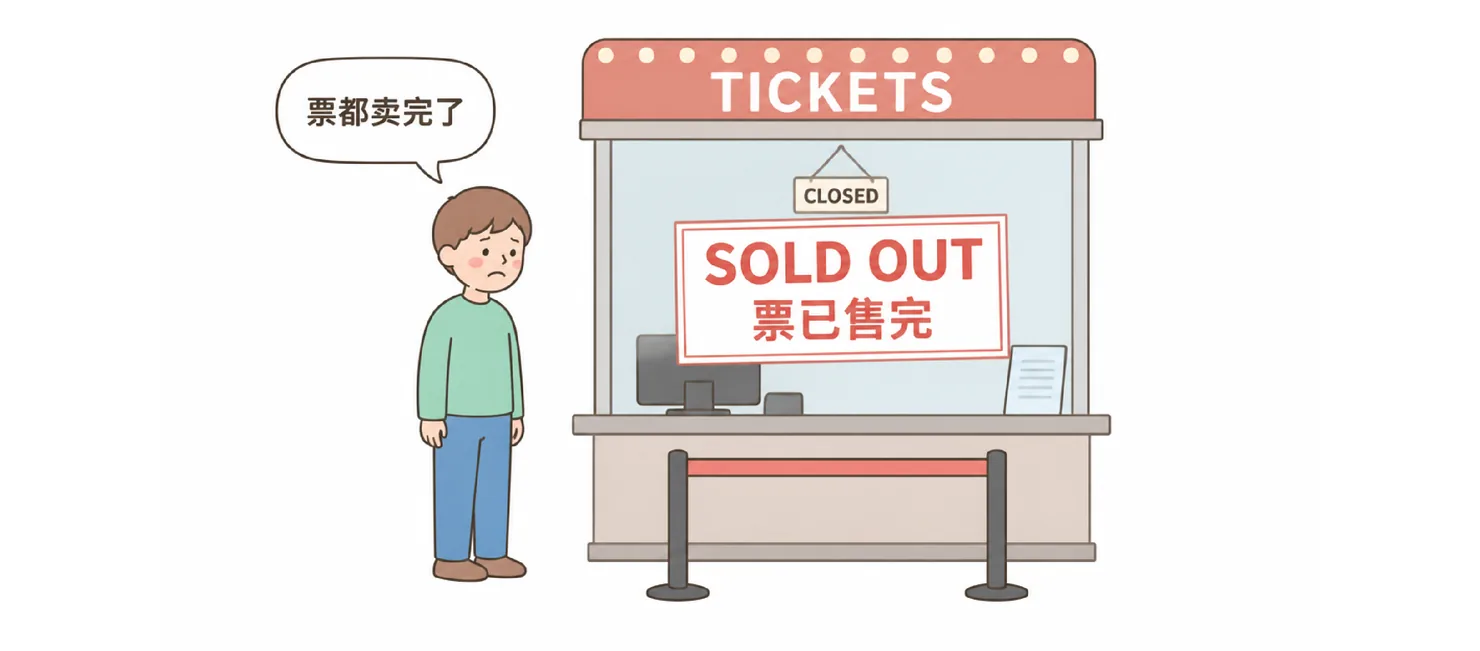 票都卖完了 — “The tickets are all sold out.” Here 完 means the supply is exhausted.
Nuance 3 — Nothing Comes Between the Verb and 完
In English the object can slide inside the phrase — "I ate it up." Chinese does not allow this. The verb and 完 form a single unit, and the object follows the pair.
The object always follows the V+完 pair; nothing goes inside it.
| Chinese | Pinyin | English | |
|---|---|---|---|
| ✅ Correct | 我吃完饭了。 | Wǒ chī wán fàn le. | I finished my meal. |
| ❌ Incorrect | 我吃了完饭。 | Wǒ chī le wán fàn. | 了 cannot separate 吃 and 完. |
| Chinese | Pinyin | English | |
|---|---|---|---|
| ✅ Correct | 他做完作业了。 | Tā zuò wán zuòyè le. | He finished his homework. |
| ❌ Incorrect | 他做了完作业。 | Tā zuò le wán zuòyè. | 了 cannot separate 做 and 完. |
Negation — Use 没, Not 不
To say an action did not finish, place 没 before the V+完 pair. 不 is wrong here: it belongs to present/future or habitual statements, and to the potential form below.
Negate with 没 before the V+完 pair — never 不.
| Chinese | Pinyin | English | |
|---|---|---|---|
| ✅ Correct | 我没吃完饭。 | Wǒ méi chī wán fàn. | I didn’t finish eating. |
| ❌ Incorrect | 我不吃完饭。 | Wǒ bù chī wán fàn. | 没 is for completed actions, not 不. |
| Chinese | Pinyin | English | |
|---|---|---|---|
| ✅ Correct | 他没看完电影。 | Tā méi kàn wán diànyǐng. | He didn’t finish watching the movie. |
| ❌ Incorrect | 他不看完电影。 | Tā bù kàn wán diànyǐng. | 没 is for completed actions, not 不. |
The one place 不 appears: the potential form, meaning “cannot finish” — 吃不完 (chī bu wán, can’t finish eating), 写不完 (xiě bu wán, can’t finish writing), 做不完 (zuò bu wán, can’t finish doing). Its positive counterpart uses 得: 吃得完 (chī de wán, can finish eating).
Quick Reference
| Point | Summary |
|---|---|
| Meaning | 完 = finish / complete / used up |
| Attachment | directly after the verb — nothing in between |
| Object position | after the V+完 pair (我吃完饭了) |
| Negation | 没 for completed actions; 不 only in the potential form |
| 完 vs 好 | 完 = reached the end · 好 = done properly, ready |
| Common verbs | 吃, 看, 写, 做, 喝, 用, 卖, 买 |
Drills
Fill in the correct result complement. Choose from 完 / 好 / 到. Each question’s English meaning is the hint.
- 我吃___饭了。(I finished eating.)
- 作业做___了吗?(Have you finished your homework?)
- 他没看___那本书。(He didn’t finish reading that book.)
- 票都卖___了。(The tickets are all sold out.)
- 你吃___药再睡觉。(Take your medicine first, then sleep.)
- 这本书我看___了,很有意思。(I finished reading this book.)
- 钱花___了。(The money is all spent.)
- 水用___了,我去买。(The water is used up.)
- 饭已经做___了,快来吃吧。(The meal is ready — done properly.)
- 你准备___了吗?(Are you ready?)
- 我在超市买___那种茶了!(I managed to buy that kind of tea.)
- 我找___钥匙了。(I found the keys.)
Answer Key: 1. 完 2. 完 3. 完 4. 完 5. 完 6. 完 7. 完 8. 完 9. 好 10. 好 11. 到 12. 到
Notes
- Many V+完 pairs work as fixed vocabulary chunks: 吃完, 看完, 写完, 做完, 喝完, 用完, 卖完.
- 完 needs a verb with a natural end point — it cannot attach to states like 喜欢 or 知道.
- 了 is very common with 完 in speech (吃完了) but is not always obligatory, since 完 already implies completion.
- For the full family of complements and how they compare, see result complements.
Sources
HSK Standard Course 2 — L9 (结果补语, result complements introduced) HSK Standard Course 3 — L6 (V得/不 + RC, potential form)