Degree Adverbs — From "A Little" to "Extremely"
Overview
If you have ever tried to say something is "very good" or "a little tired" in Chinese, you have probably faced a confusing choice: 很, 非常, 特别, 极了, or 死了? Unlike English, which just uses "very" for most situations, Chinese divides these intensifiers into three clear levels (Medium, Strong, Extreme). Furthermore, some of these words are actually grammatical linkers rather than true intensifiers, and some must be placed after the adjective instead of before it. This guide gives you a complete, structured overview — the most common degree adverbs, their exact positions, their intensity levels, and what to do when a literal translation sounds unnatural.
Chinese sorts its intensifiers (很, 非常, 特别, 极了, 死了…) into three levels — and some are grammatical linkers rather than "very," while others go after the adjective. This guide covers each one's meaning, intensity, and position.
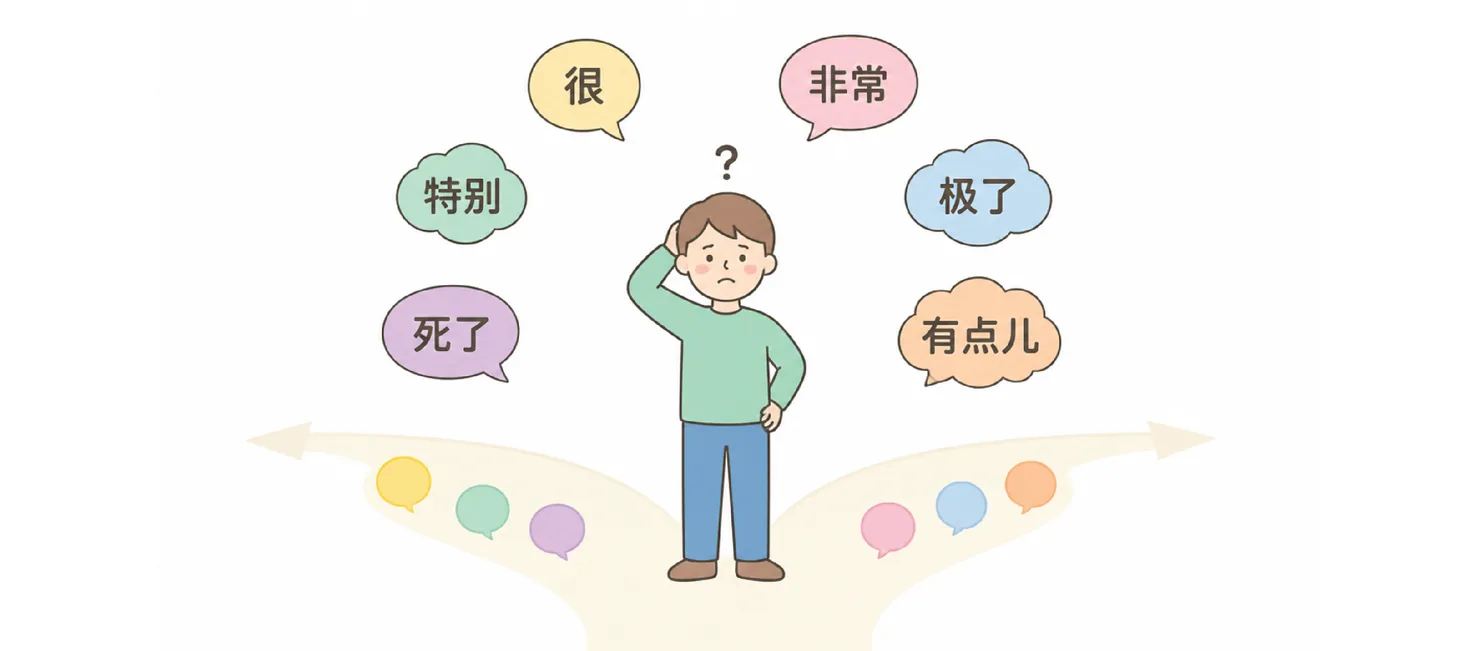 So many ways to say “very” — this guide sorts them by intensity and position.
Summary Table — Core Degree Adverbs
| Term | Pinyin | Intensity | Position | Example | Pinyin | English |
|---|---|---|---|---|---|---|
| 有点儿 | yǒudiǎnr | Low (a little) | Before Adj. | 今天有点儿冷。 | Jīntiān yǒudiǎnr lěng. | Today is a little cold. |
| 很 | hěn | Medium (linker) | Before Adj. | 她很漂亮。 | Tā hěn piàoliang. | She is beautiful. (neutral) |
| 非常 | fēicháng | Strong (very) | Before Adj. | 非常感谢你。 | Fēicháng gǎnxiè nǐ. | Thank you very much. |
| 特别 | tèbié | Strong (especially) | Before Adj. | 这个菜特别好吃。 | Zhège cài tèbié hǎochī. | This dish is especially tasty. |
| 极了 | jíle | Extreme (max) | After Adj. | 好极了! | Hǎo jíle! | Excellent! / Fantastic! |
| 死了 | sǐle | Extreme (colloq.) | After Adj. | 累死了! | Lèi sǐle! | Exhausted! (tired to death) |
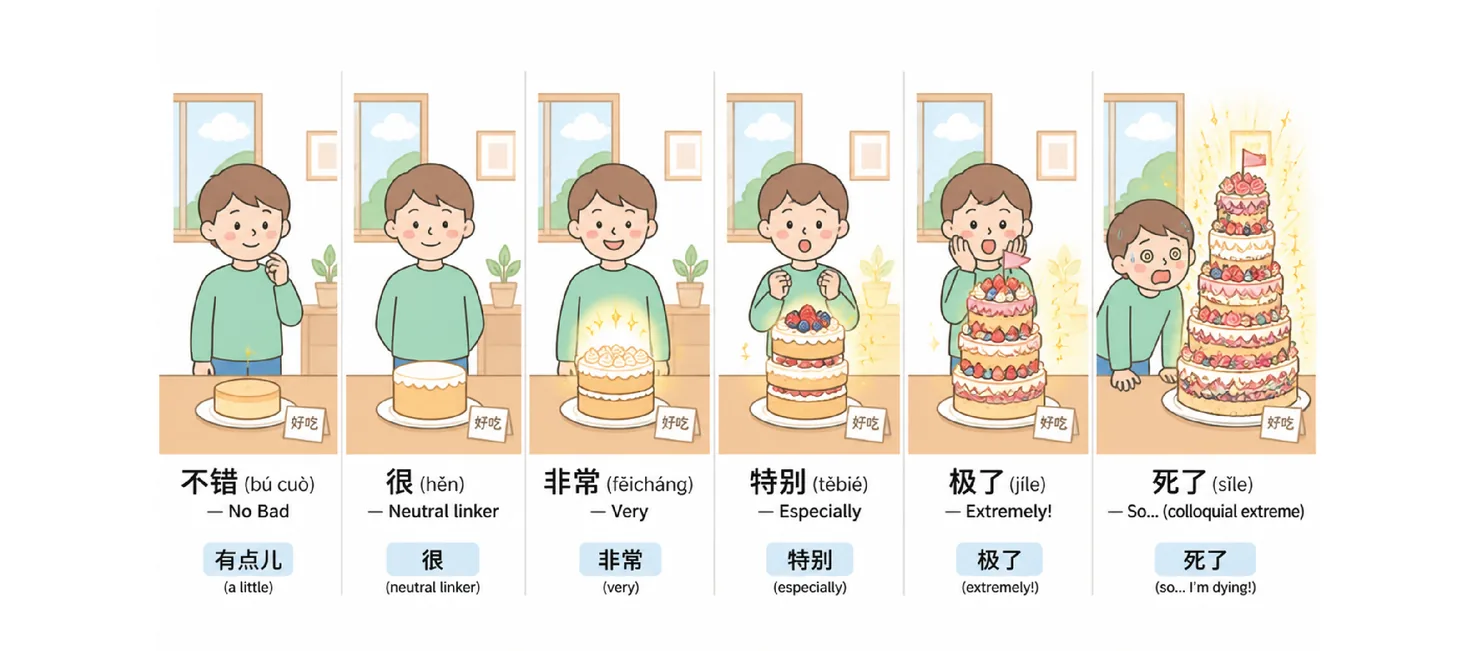 From a plain “not bad” (不错) all the way up to “dying” (死了) — six degrees of intensity.
Where Do They Go? — Core Structure
Before looking at meanings, you must understand the two position groups. This is the most basic rule: most degree adverbs come before the adjective, but the two "extreme" phrases 极了 and 死了 come after it.
Most degree adverbs go before the adjective; only 极了 and 死了 go after it.
| Group | Words | Structure |
|---|---|---|
| Group 1 — before the adjective | 有点儿, 很, 非常, 特别, 极, 死 | Subject + Adverb + Adjective |
| Group 2 — after the adjective | 极了, 死了 | Subject + Adjective + Adverb |
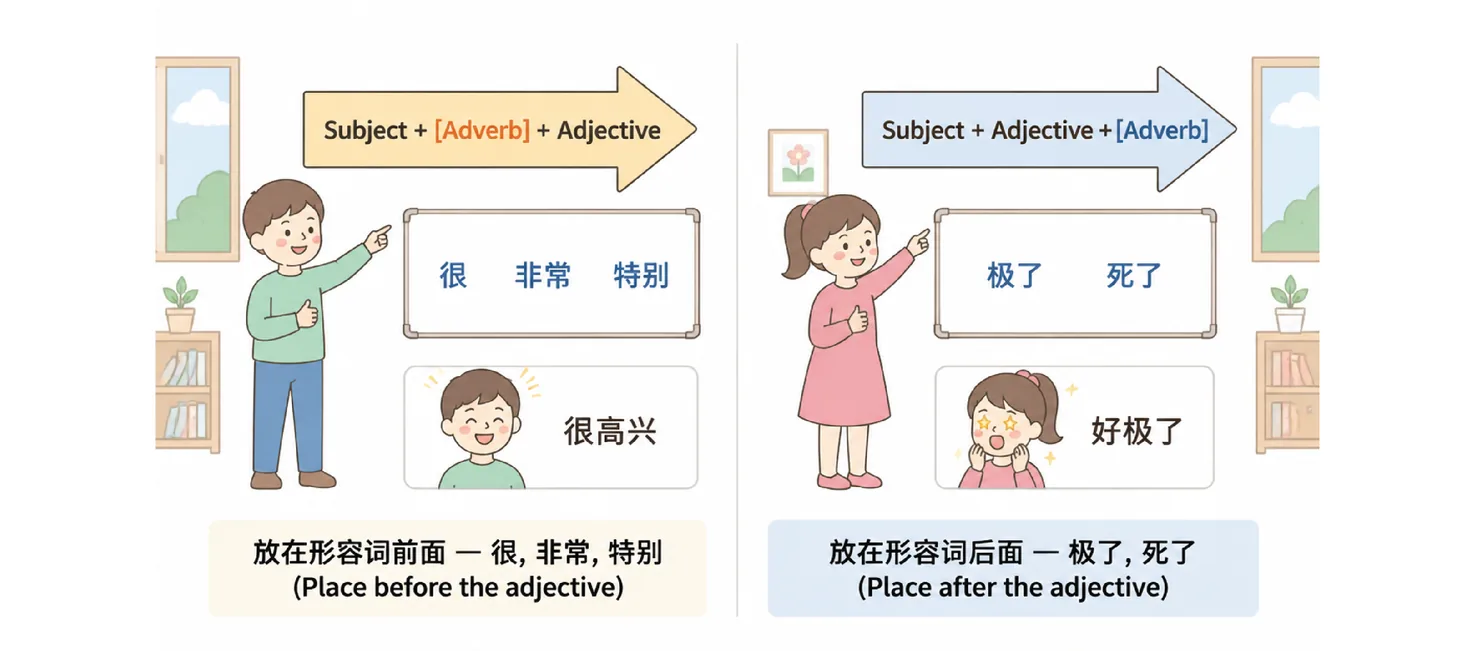 Group 1 (很, 非常, 特别) goes before the adjective; Group 2 (极了, 死了) goes after it.
Important note: You can never swap these positions.
| Chinese | Pinyin | English | |
|---|---|---|---|
| ✅ Correct | 很好 | Hěn hǎo. | Very good. / Good. |
| ❌ Incorrect | 好很 | Hǎo hěn. | Incorrect — 很 must come before the adjective. |
| Chinese | Pinyin | English | |
|---|---|---|---|
| ✅ Correct | 好极了 | Hǎo jíle. | Excellent. / Very good. |
| ❌ Incorrect | 极了好 | Jíle hǎo. | Incorrect — “extremely” cannot come before 好 here. |
Intensity Levels — Detailed Breakdown
Each section below covers one intensity level in detail — what the word does, where it goes, and native examples. Click any section to expand it.
Tap any section below to expand its full explanation and examples.
有点儿
What it does: 有点儿 expresses a mild degree, usually when something is slightly negative or just barely noticeable. It is the direct opposite of "very". Position: always before the adjective. Usage tip: 有点儿 is often used with adjectives describing discomfort, difficulty, or subjective feelings.
有点儿 = "a little" — a mild degree, usually for something slightly negative or uncomfortable. Always goes before the adjective.
| Chinese | Pinyin | English |
|---|---|---|
| 今天有点儿忙 | Jīntiān yǒudiǎnr máng. | Today is a little busy. |
| 这个汤有点儿咸 | Zhège tāng yǒudiǎnr xián. | This soup is a little salty. |
 今天有点儿忙 — A little busy today.
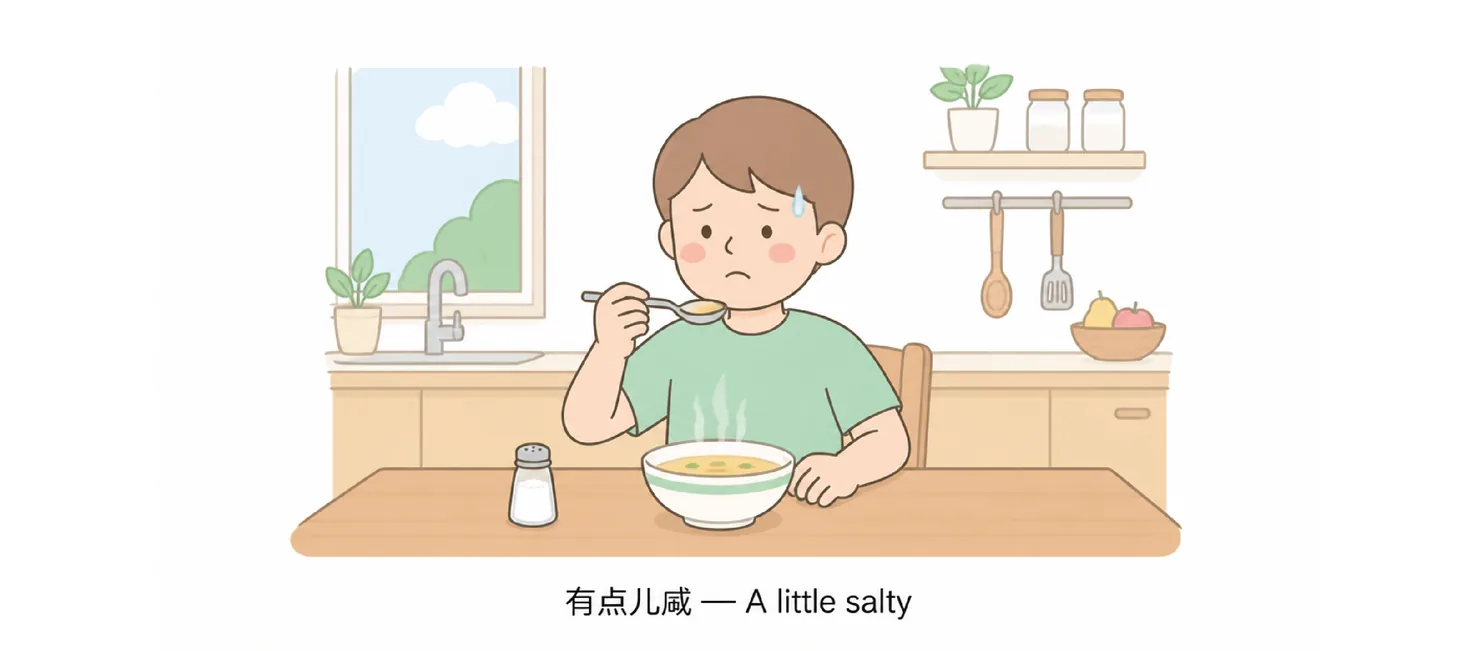 这个汤有点儿咸 — This soup is a little salty.
很
What it does: 很 is the most common word, but it rarely means "very" in the English sense. In a simple statement (e.g., "She is happy"), Chinese grammar requires a word before the adjective to link the subject and the description. 很 fills this role without adding strong emotion. Position: always before the adjective. Critical rule: When you say 她很高兴, it usually just means "She is happy" — not "She is very happy". Only if you stress the 很 (HĚN) does it mean "very".
很 is a neutral linker, not really "very." 她很高兴 just means "she is happy"; stress 很 to actually mean "very." Always before the adjective.
| Chinese | Pinyin | English |
|---|---|---|
| 她很高 | Tā hěn gāo. | She is tall. — neutral fact |
| 天气很好 | Tiānqì hěn hǎo. | The weather is good. — neutral |
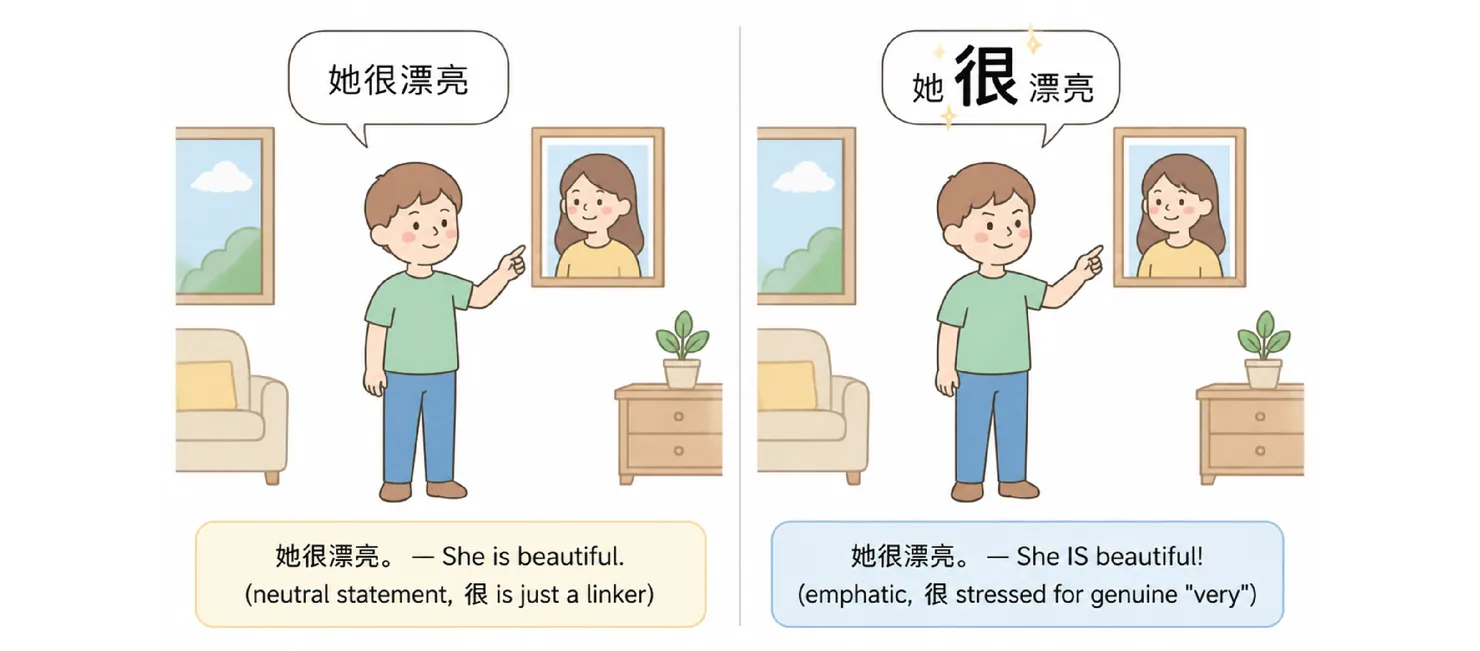 她很漂亮 — neutral (“she is beautiful”) vs. stressed 很 (“she IS beautiful!”).
非常 / 特别
What they do: When you genuinely want to emphasize "very" or "extremely", use these two. 非常 is standard and polite, perfect for formal compliments or gratitude. 特别 literally means "special", but when placed before another adjective, it means "especially" or "particularly". Position: both go before the adjective.
非常 = "very" (standard, polite); 特别 = "especially / particularly." Both go before the adjective.
| Chinese | Pinyin | English |
|---|---|---|
| 这个城市非常干净 | Zhège chéngshì fēicháng gānjìng. | This city is very clean. |
| 今天的作业特别多 | Jīntiān de zuòyè tèbié duō. | Today’s homework is especially a lot. |
 非常感谢你 — Thank you very much.
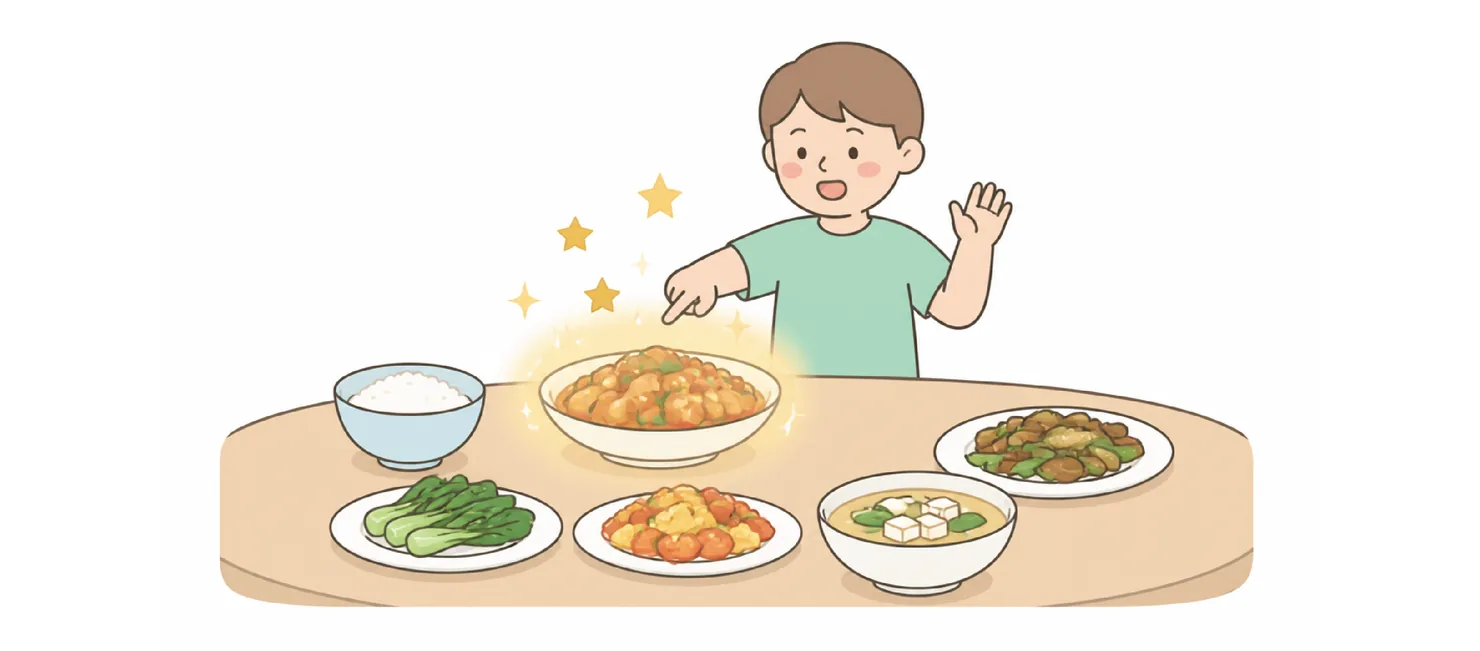 这个菜特别好吃 — This dish is especially tasty.
极了 / 死了
What they do: These turn an adjective into a strong exclamation. They are not calm descriptions; they express a sudden, strong feeling. Position: both go after the adjective. 极了 is standard and used for all kinds of excited reactions (positive or negative). 死了 is very colloquial (spoken slang) — usually with tiring, uncomfortable, or surprising states like 饿 (hungry), 累 (tired), or 忙 (busy). Do not use it in formal writing.
极了 and 死了 turn an adjective into a strong exclamation and go after it. 极了 is standard; 死了 is casual slang for tiring/uncomfortable states — avoid it in writing.
| Chinese | Pinyin | English |
|---|---|---|
| 快极了! | Kuài jíle! | So fast! / Extremely fast! |
| 饿死了,我们去吃饭吧 | È sǐle, wǒmen qù chīfàn ba. | Starving! Let’s go eat. — informal |
 好极了! — Excellent! / Fantastic!
 累死了! — Exhausted! / So tired I could die!
📌 What about 极 without 了? You may have learned that 极 can also go before the adjective. That is correct — but it applies to the single character 极 (without 了), not the fixed phrase 极了.
| Form | Word Type | Position | Example | English |
|---|---|---|---|---|
| 极了 | degree complement (fixed phrase) | After Adj. | 好极了 | Excellent! |
| 死了 | degree complement (fixed phrase) | After Adj. | 累死了 | Exhausted! |
| 极 | degree adverb (alone, without 了) | Before Adj. | 极好 | Extremely good |
For HSK 3, you will mostly use 极了 and 死了 as fixed phrases placed after the adjective. The single character 极 (before adjectives) is more formal and less common in daily conversation. Just remember: if you see 极了, it goes after; if you see only 极, it goes before.
Special Cases and Important Rules
A. The “False Friend” — 很 is not always “Very”
This is the single most common mistake. In English, we say "She is beautiful." In Chinese, if you say 她漂亮 without 很, it sounds like you are contrasting her with someone else ("She is beautiful, but…"). To make a simple, neutral statement, you must put 很 before the adjective. Think of 很 as a grammatical bridge, not a translation of "very".
很 is a grammatical bridge, not "very." 她漂亮 (without 很) sounds contrastive/incomplete — a neutral statement needs 她很漂亮.
| Chinese | Pinyin | English | Why |
|---|---|---|---|
| 她很漂亮。 | Tā hěn piàoliang. | She is beautiful. | Neutral statement. |
| 她漂亮。 | Tā piàoliang. | She is beautiful (in contrast). | Sounds incomplete or contrastive. |
| 她非常漂亮。 | Tā fēicháng piàoliang. | She is very beautiful. | Strong, genuine emphasis. |
B. The Awkwardness of “有点儿 + Positive Adjective” — use 不错
In Chinese, we almost never say 有点儿好 (a little good) or 有点儿漂亮 (a little beautiful). "A little" + a purely positive quality sounds illogical and unnatural to native speakers. The fix: if you want to say something is "not bad" or "pretty good" (a mild positive), use the adjective 不错 (bùcuò). 不错 is an adjective itself, meaning "not bad / pretty good". It does not need a degree adverb in front of it; it stands alone.
Don't say 有点儿好 / 有点儿漂亮 — "a little" + a positive quality is unnatural. For a mild positive, use 不错 ("not bad / pretty good"), which stands alone.
| Chinese | Pinyin | English | |
|---|---|---|---|
| ✅ Correct | 今天不错 | Jīntiān bú cuò. | Today is not bad / pretty good. — Natural |
| ❌ Incorrect | 今天有点儿好 | Jīntiān yǒudiǎnr hǎo. | Today is a little good. — Awkward |
| Chinese | Pinyin | English | |
|---|---|---|---|
| ✅ Correct | 他的中文不错 | Tā de Zhōngwén bú cuò. | His Chinese is not bad. — Natural |
| ❌ Incorrect | 他的中文有点儿好 | Tā de Zhōngwén yǒudiǎnr hǎo. | His Chinese is a little good. — Awkward |
Quick rule: Reserve 有点儿 for neutral or slightly negative adjectives (有点儿累, 有点儿贵). For mild positive feedback, skip the adverb and use 不错 directly.
 天气有点儿好 ❌ (awkward) — 天气不错 ✅ (natural).
Comparison — Same Adjective, All Options
To see the full range, here is how the sentence “Today is good” changes depending on the degree adverb you choose.
| Example | Pinyin | Natural? | Tone / Meaning |
|---|---|---|---|
| 今天有点儿好。 | Jīntiān yǒudiǎnr hǎo. | ❌ Awkward | Literal, but unnatural. Use 不错 instead. |
| 今天不错。 | Jīntiān bùcuò. | ✅ Natural | Today is pretty good / not bad. (mild positive) |
| 今天很好。 | Jīntiān hěn hǎo. | ✅ Natural | Today is good. (neutral statement) |
| 今天非常好。 | Jīntiān fēicháng hǎo. | ✅ Natural | Today is very good. (strong, genuine praise) |
| 今天特别好。 | Jīntiān tèbié hǎo. | ✅ Natural | Today is especially good. (enthusiastic) |
| 今天好极了! | Jīntiān hǎo jíle! | ✅ Natural | Today is fantastic! (excited exclamation) |
| 今天好死了! | Jīntiān hǎo sǐle! | ⚠️ Casual | Today is so freaking good! (only with friends) |
Drills
Choose the correct word for each blank. Use the English hint under each sentence to judge the intended degree, and watch the position (before or after the adjective). Click 🔀 New Questions for a fresh set of 10 from the full 70-sentence pool.
Notes
- 有点儿 is often shortened to 有点 in speech and writing; both are correct.
- 极了 and 死了 are degree complements (they follow the adjective), while 有点儿, 很, 非常, and 特别 are degree adverbs (they precede it).
- 太 (tài) is another common “before” intensifier, usually in the frame 太……了 (太好了! “great!”).
Sources
HSK Standard Course 1 — 很, 太, 有点儿 (degree adverbs) HSK Standard Course 3 — 非常, 特别, 极了, 死了 (程度补语 degree complements) Mandarin Grammar References — Degree Adverbs chapter